All posts by Shroomworks

In 2003, my dearest and I decided to move to and build in an area surrounded by rainforest on BC's Sunshine Coast. So I thought it would be wise to learn about mushrooms. Little did I know that this new interest, combined with my joining the local spinners' and weavers' guild, would lead to a new passion: dyeing fibre with mushrooms. I was lucky enough to attend the 13th International Fungi & Fibre Symposium in Mendocino, California, in 2008, and from the good people there, I learned a great deal and was inspired to come home and learn even more. The story has just begun . . .

Possibly a Phaeolus?

Phaeolus button?

Last week I spotted a bit of yellow something growing on a small—very small—stump of a Douglas fir. I had to go back to the spot today to check it out. I was keeping my fingers crossed that it might be a Phaeolus schweinitzii. My hopes were buoyed up when I saw how much it’s grown and changed since I first saw it.

I do believe this is a young dyer’s polypore. I’ve never seen one appear this early in the year, but we’ve had an exceptionally cool, wet spring (which adds to my firm belief that this is going to be a fabulous mushroom year!). Nor have I ever seen one on such a small stump—I usually find them on the massive, moss-covered stumps left over from the logging that was done here a hundred years ago. So I could be wrong . . . updates to follow as this little fungus grows.
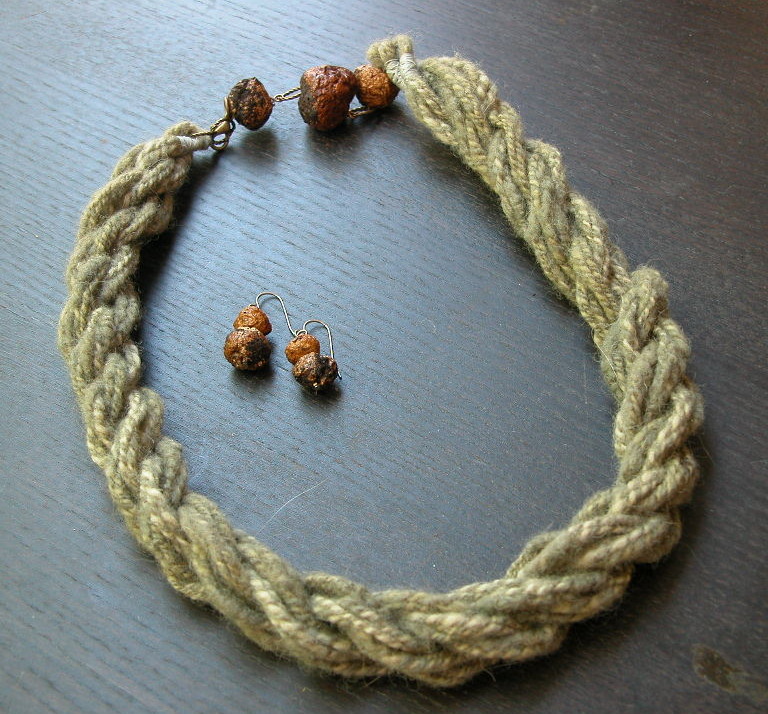
Hydnellum necklace, mushroom earrings

Hydnellum necklace

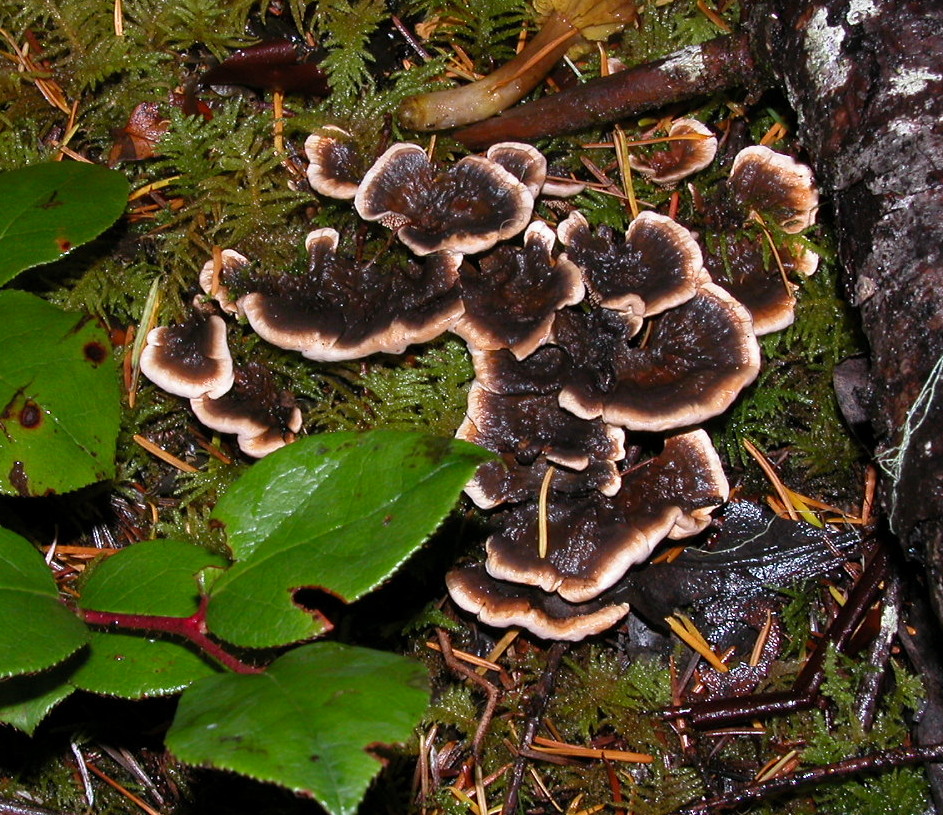
I finished these pieces just in time for a jewelry exchange among members of our spinners’ and weavers’ guild. To make the necklace, I twisted three “ropes” of a chunky thick-and-thin handspun made of wool I’d dyed with a Hydnellum (H. aurantiacum, I think, but I need to confirm that when those mushrooms are out again this fall). Then I let three of these ropes twist back on themselves, resulting in a thick cable. I bound each end of the ropes with thread, then attached a clasp and mushroom paper beads for a closure. The earrings are also made of mushroom paper beads.

I’m particularly pleased that this soft green is the perfect colour for the person whose name I drew, and I hope she’s pleased with it, too.

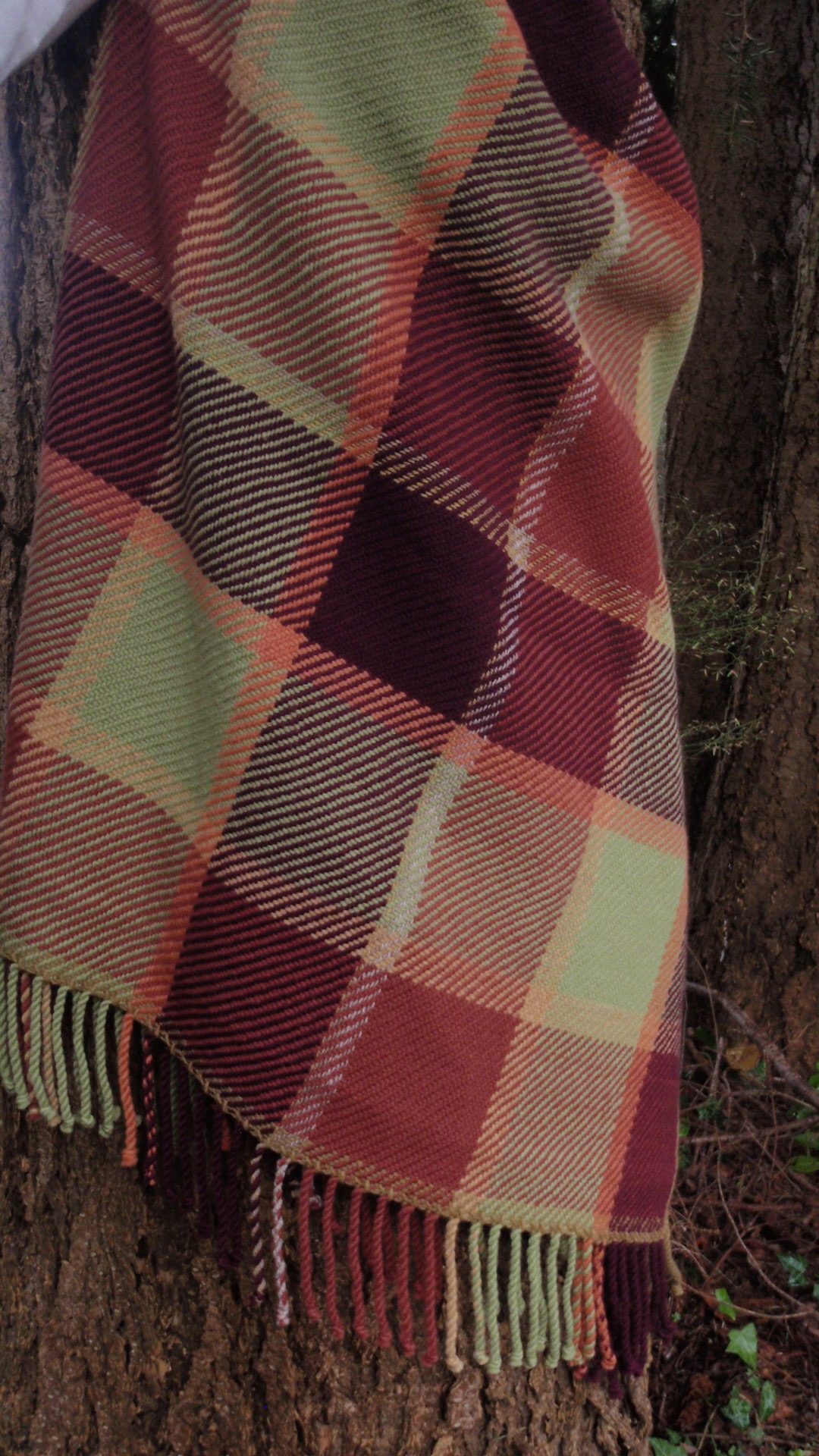
Deanna’s Forest Floor Blanket

Forest Floor Blanket

My dear friend and wonderful weaver, Deanna Pilling, unveiled her Forest Floor plaid at today’s Guild meeting (Sunshine Coast Spinners and Weavers).  The narrow pink and orange stripes are of yarn I dyed with mushrooms; the lighter middle stripe came from blackberry leaves and berries and was dyed by another weaver.

Deanna spent a lot of time deciding on the rest of the colours that make up this plaid; together they represent our rainforest with the rich hues of cedar, arbutus and soft green moss.

Lovely!

Love these Hydnellum greens

Hydnellum textured yarn

This is such a soft, rich green. I found a good number of Hydnellum aurantiacum in the fall, enough for quite a large dyepot. I put a succession of rovings through three exhausts, then spun them into textured yarns, using the various shades of the same colour.

I’d read that shifting the pH to the alkaline side on this one can sometimes result in a blue, but I had no such luck. In fact, even at pH 11, I noticed little difference in the colours.

I have plans for this skein, involving a secret gift exchange among members of my spinners’ and weavers’ guild, but that’s all I’m going to say for now.

Hydnellum aurantiacum

Spinning something yellow

Sulfur tuft roving

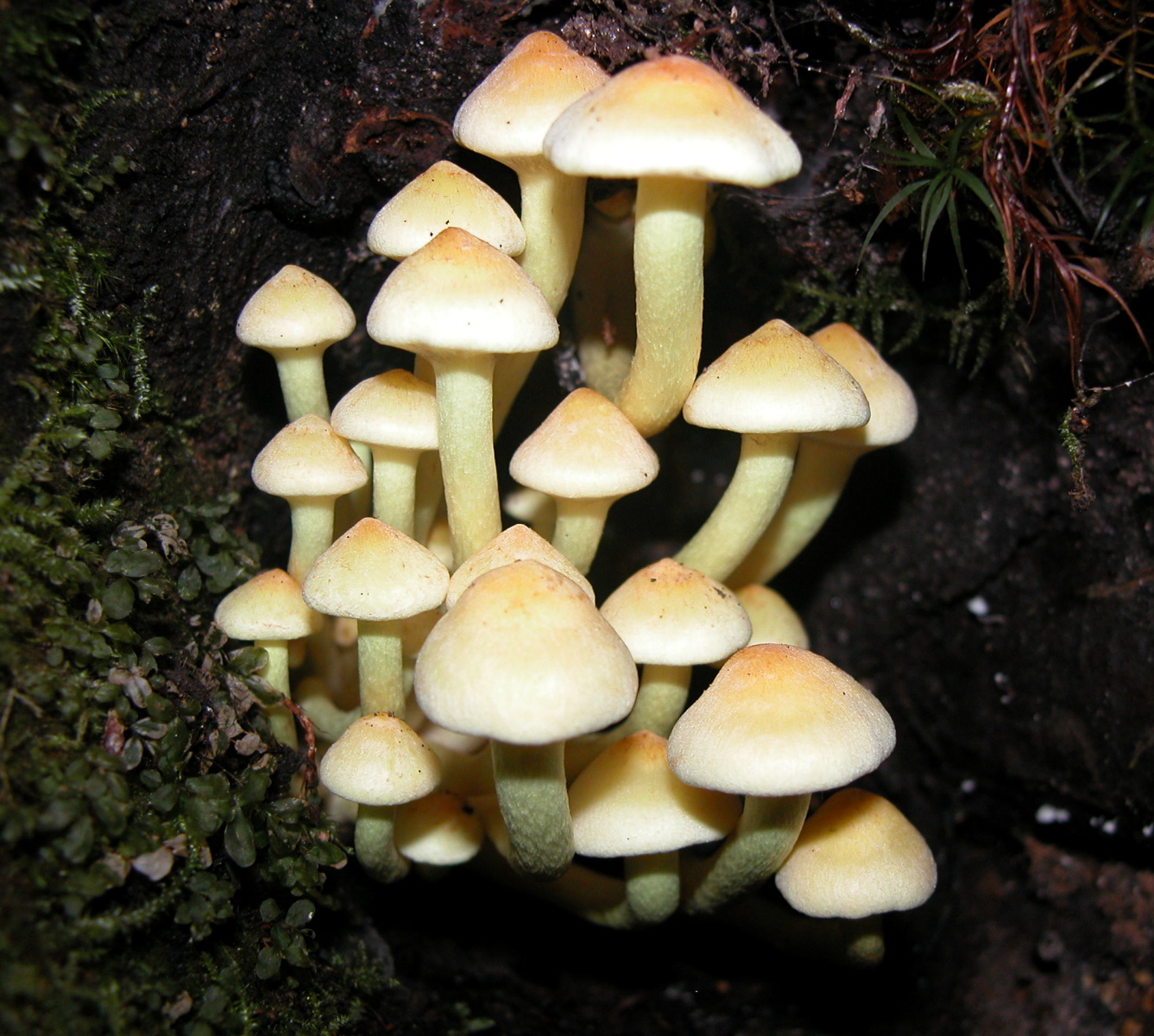
In the world of natural dyeing, pale yellow is almost something to yawn at – it’s so easy to get with any number of grasses, leaves and weeds. However, the sulfur tuft (Hypholoma fasciculare, formerly Naematoloma fasciculare) is one of the first dye mushrooms to appear in the fall, usually in early September, so I love to get a dyepot of its good, fresh colour going as a start to the dyeing season. I’ve tried letting the mushrooms dry and also leaving a fresh dyepot to sit for a week or two, and in both cases, the colour became more drab and less exciting.

Another reason I love this little mushroom is because it’s the one Miriam Rice threw into a dyepot some forty years ago, merely out of curiosity if it would give any colour (she’d been experimenting with other natural dyes, but never with mushrooms). Fortunately for us, she’d picked a cluster of sulfur tufts, one of the few mushrooms that does give a good colour. Had it been one of the many fungi that give a nice mushroom brown, I, and many others, probably wouldn’t be dyeing with mushrooms today!

This is some sulfur tuft roving I dyed last fall, and this ply will be the wrapping for a spiral or boucle yarn.

Sulfur tufts

The finished yarn

Merino on the bobbin

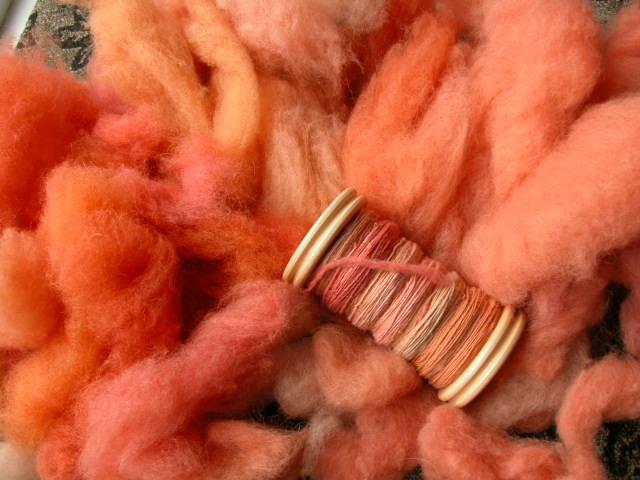
These colours came from varieties of Cortinarius semisanguineus, mushrooms that look like LBMs (little brown mushrooms) from above, but whose brilliant red, orange and gold gills attest to the pigments they contain. After saving two years’ worth of  dye experiments, it was time to spin them up. I’d used two kinds of wool – Merino and Corriedale – and separated them out, easily done by feel. I spun the Merino first, shown here on the bobbin, then spun the Corriedale on another bobbin. Colours always look brighter in unspun fibre; spinning and plying soften them somewhat.

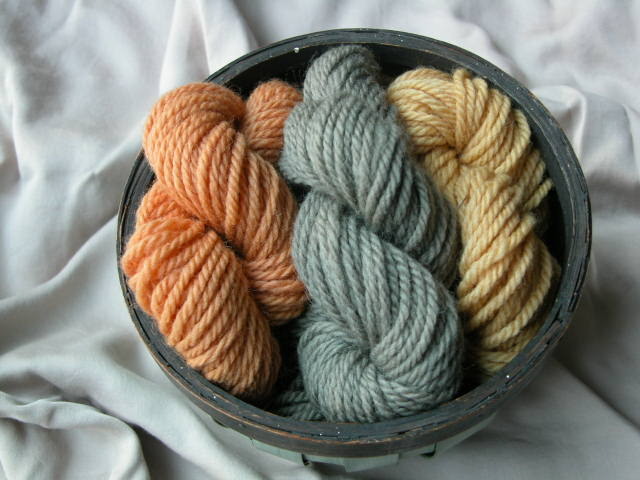
I plied the two bobbins together into a textured yarn, enough for two skeins. With some Merino left on the bobbin, I Navajo-plied it to get a three-ply yarn with distinct colour breaks.

The last of this year’s dermocybes are simmering now in my slow cooker, and I’m dyeing silk with them. I’m saving the Cortinarius sanguineus to the end, as the colour is sure to be spectacular, although on the silk it won’t be as brilliant as if I were dyeing wool.

Dermocybe yarn

What I’m spinning now

Two years’ worth of rovings

It’s time I started doing something about my stash – well, some if it, anyway – so I gathered up all the bits and pieces of roving that went through the dermocybe dyepots over the last two years.

I found I had two kinds of wool: soft, silky Merino (the pile on the left) and coarser Corriedale (right). The Merino, which felts more easily anyway, has a lot of little slubs throughout – if I dye with it again, I’ll have to be more careful not to move it around too much when it’s in the hot dyebath.

I hand-carded the wool, to open up the fibres and line them up for spinning.

My plan is to spin one bobbin of Merino and one of Corriedale, then ply them together, thus getting the best of both wools. I’ll put the colours together at random, so when the yarn is finished, it should be an interesting blend courtesy of the little Cortinarius that grow in the woods around us.

From a cold dyepot

Dyed in a cold dyepot

Back in October, when more and more dye mushrooms were coming home with me and the dyepots never cooled down, I’d finished with a good batch of Dyer’s Polypore (Phaeolus schweinitzii) but didn’t have time to do the exhausts, so I stuck the pot outside on my mudroom steps, with all the chunks of mushrooms going back into the dyebath.

At the same time, I found myself wondering what to do with a silk blouse that had a stain on the front. Aha! I thought. Let’s see if it can pick up any colour, and if the colour’s uneven and blotchy, so much the better.

It was a good six weeks before I got back to that dyepot, and even though parts of the blouse had been sitting right on the mushrooms all that time, the colour turned out to be quite even; too even, in fact – the stain still shows! (In the picture is a scarf from the original dyebath – I’ve embellished it with some mushroom beads.)

This is worth experimenting with next year, when I end up with more Phaeolus than my dyepots can accommodate. In the meantime, I still have to come up with some way of hiding that stain!