In 2003, my dearest and I decided to move to and build in an area surrounded by rainforest on BC's Sunshine Coast. So I thought it would be wise to learn about mushrooms. Little did I know that this new interest, combined with my joining the local spinners' and weavers' guild, would lead to a new passion: dyeing fibre with mushrooms. I was lucky enough to attend the 13th International Fungi & Fibre Symposium in Mendocino, California, in 2008, and from the good people there, I learned a great deal and was inspired to come home and learn even more. The story has just begun . . .
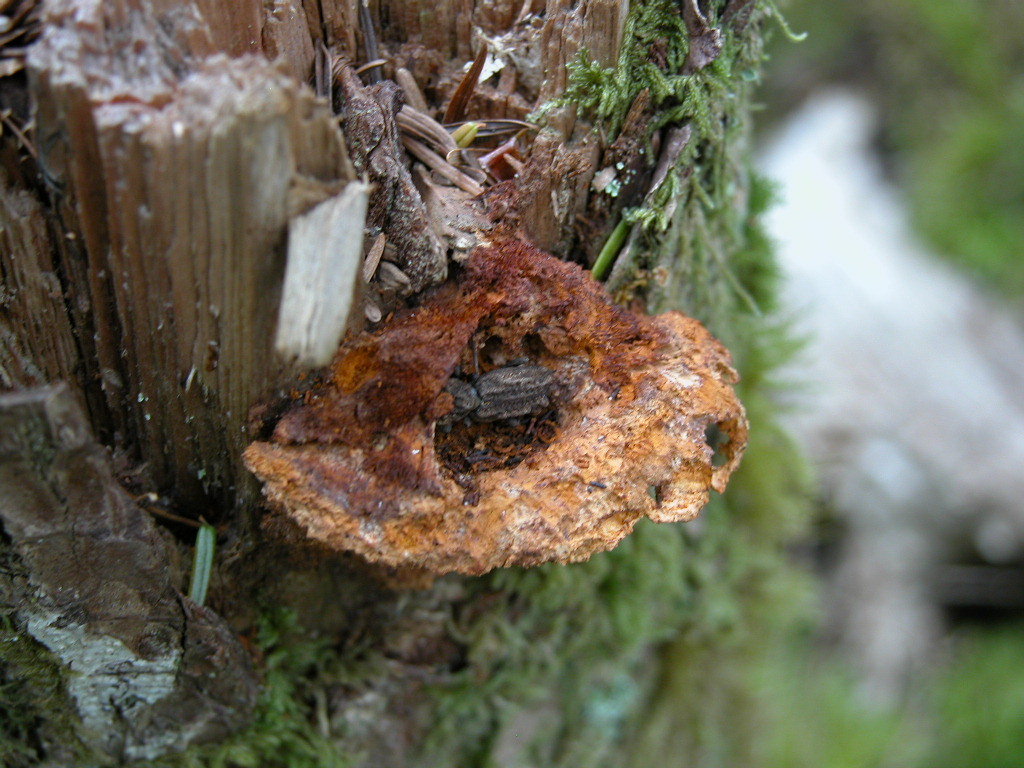
In an earlier post I described how I trimmed the young edges from a cluster of Phaeolus schweinitzii, to see if the fungus would grow back. That was on September 20; I went back to the same tree on October 13, to find that the polypore had indeed sent out new growth, although it was much thinner than the first growth and without the yellow fuzzy edges.
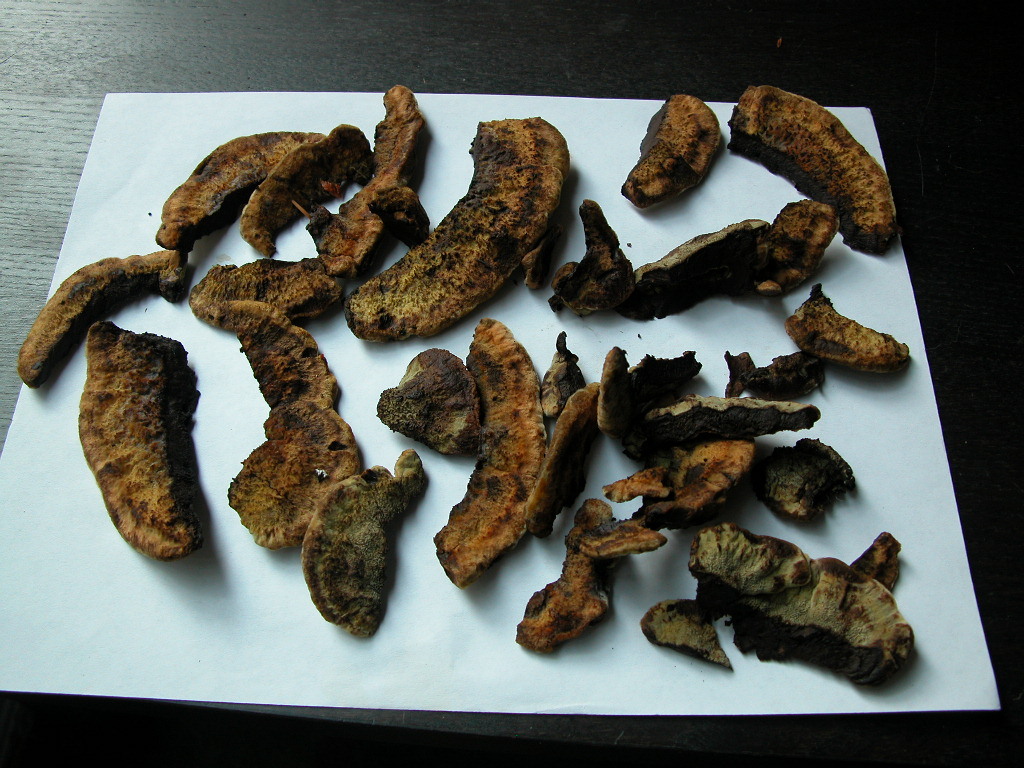
My dyepots—the large one on the propane burner outside under the deck, the small one on my hotplate in the mudroom, and my Crockpot—aren’t cooling down, and they’re all filled with Dyer’s Polypore. I keep finding beautiful young ones, still with their yellow fuzz—and people keep giving me ones they’ve found! I need to process them before they go brown, to get the best of their popping golds. I’m keeping the chunks of polypore after they’ve been through one boiling. Once mushroom season settles down (not that I’m wishing for that to happen), I’ll boil them up again and see what comes out of the exhausts.
In addition to wool rovings, I’m dyeing silk hankies, mohair, llama, Tencel, and even dog hair, which picked up the colour beautifully.
Before I forget . . . I want to see what it does to my own hair!
I obtained these huge specimens on the weekend (see the quarter for perspective) at the Sunshine Coast Mushroom Festival here in Pender Harbour. A friend brought in the huge Velvet Pax on the left (Tapinella atrotomentosa) for the ID table. This is in my dyepot at the moment, and I have high hopes for the greens, greys and maybe even mauves that it’s going to give me.
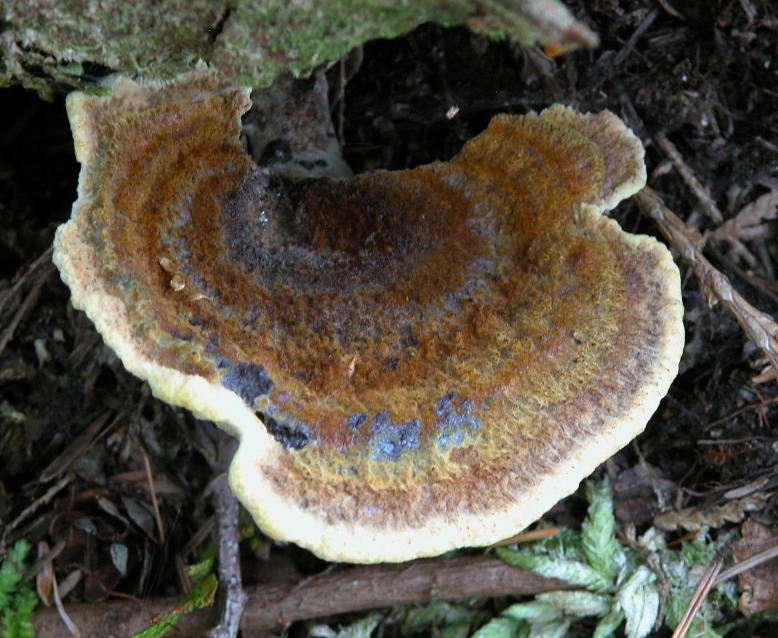
Then on our foray with Larry Evans Sunday, I found the biggest Dyer’s Polypore (Phaeolus schweinitzii) I’ve ever seen, at the base of a very, very old Douglas fir. The tree stood no more than eight feet tall, but it stood straight. Woodpeckers and birds had taken their toll, and it was devoid of bark, ready to collapse soon. I saw the remains of several old Phaeolus around its trunk, and peering out from a hollow under a giant old root, this fabulous beauty caught my eye.
I’m finding so many beautiful dyer’s polypore this year, and the variations on gold are never-ending! I put these mordanted rovings in the dyepot together, knowing that the iron might affect the colours on the other two, which were mordanted with alum and copper. And it did, but not in a bad way. The colour produced by two good-sized clusters was so rich and strong that the iron’s “saddening” effect added some depth to the gold of the alum roving and to the rust brown of the copper one. (The iron roving is dark green.)
And then there’s the brilliant gold that took my breath away . . . this came from another two fresh clusters of dyer’s polypore, with enough pigment left over to have an exhaust dyebath (the wool on the right).
Here are the results of my first real dyepot of the year, using the trimmings from the Phaeolus cluster that I mentioned in my last post. This year I’m going to concentrate on dyeing unspun fibre so I can play with the colours as I spin yarn with them.
The gold roving was mordanted with alum, the green with iron and the rich brown with copper.
I tried putting some more wool through the same dyebath, but the colours were lacklustre, to say the least. But I love what I got from this dyepot!
After a few days of good rain last week, I expected to find something interesting in the forest today. And indeed I did!
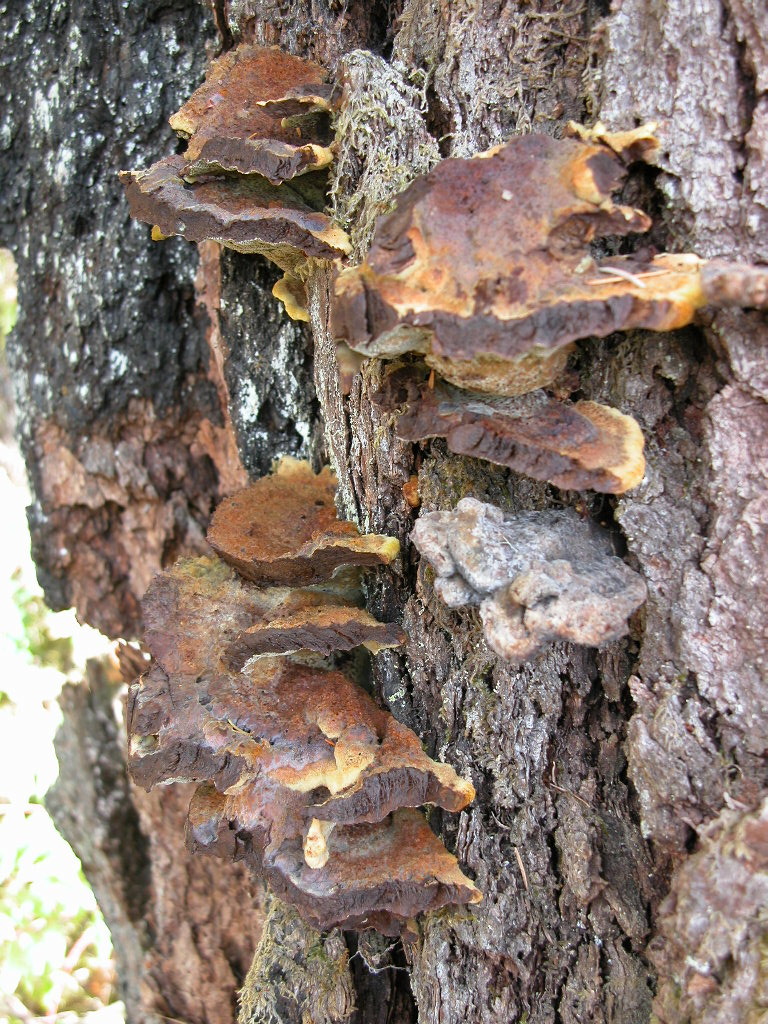
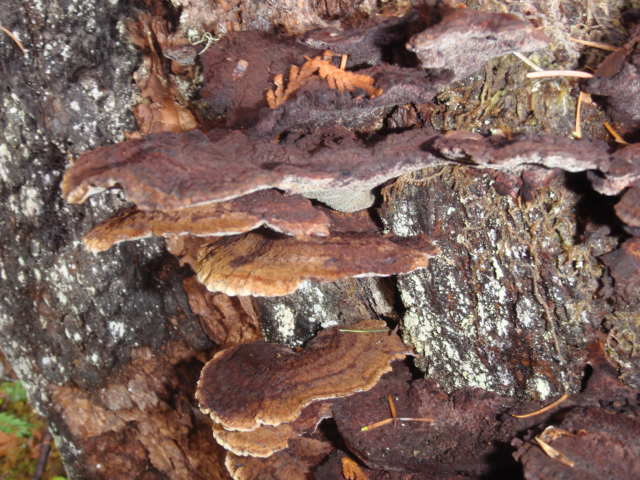
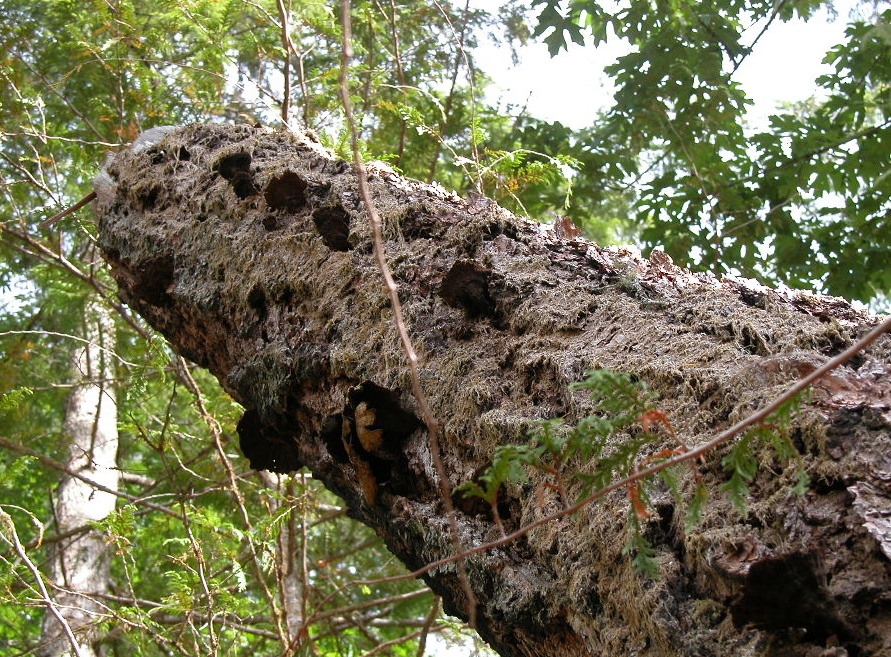
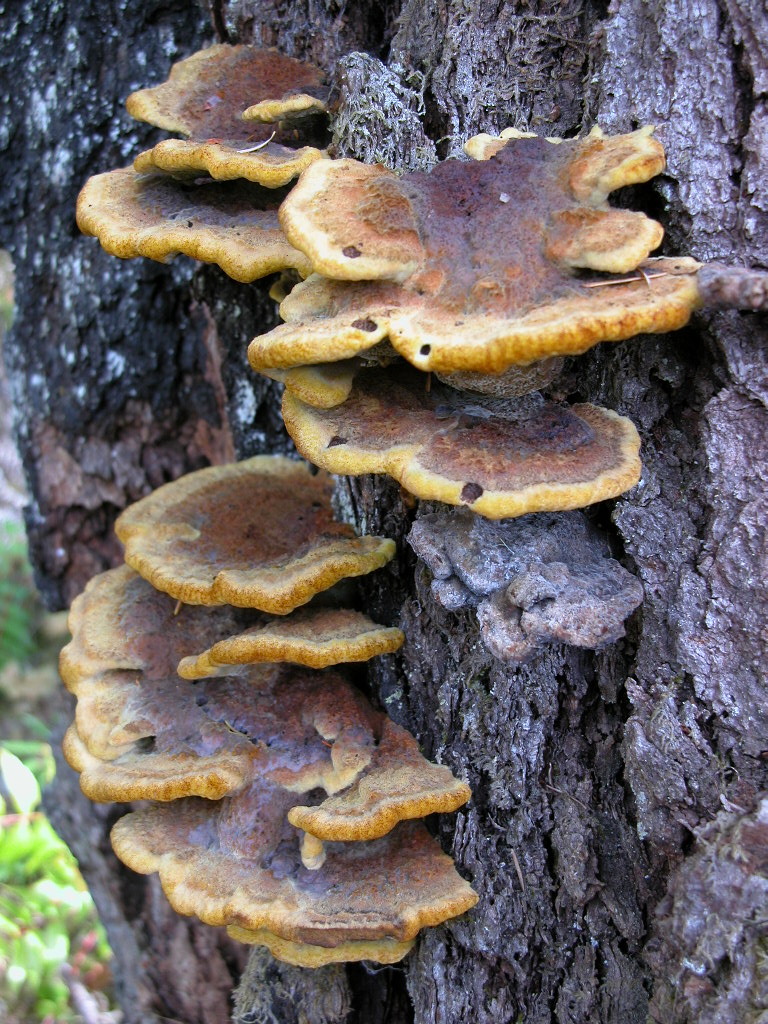
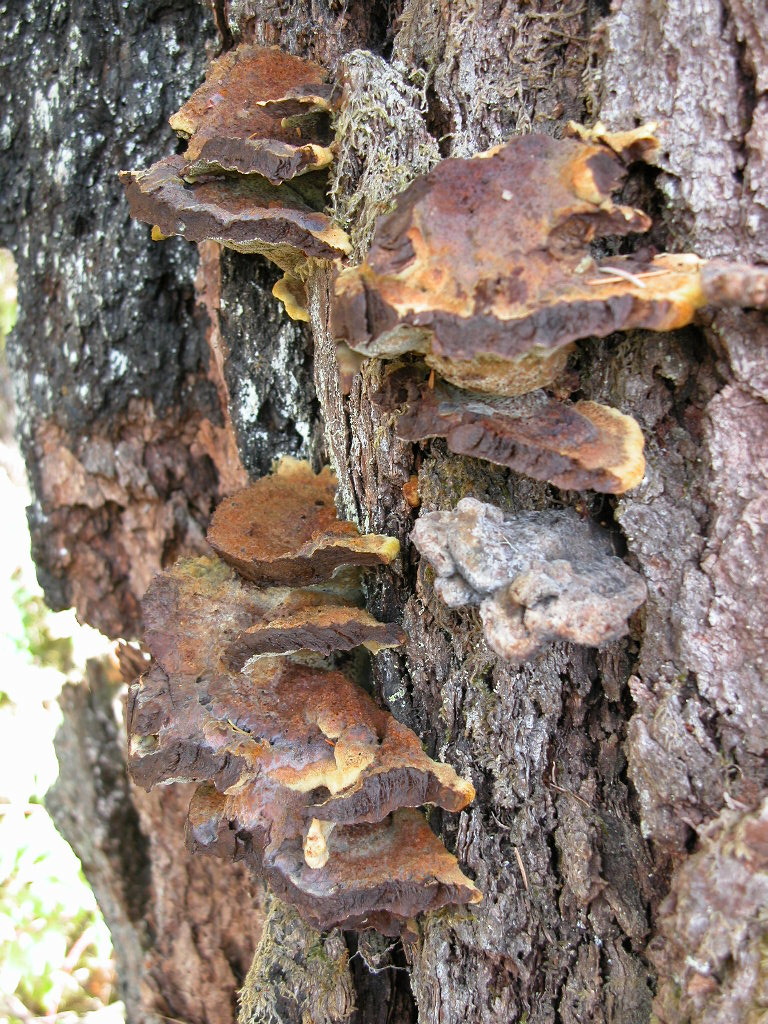
I went to check out my “nurse tree” for Dyer’s Polypore. From the number of old specimens still clinging to it (see the brown “bumps” running up the trunk, all well above my reach), it’s clear this old snag must be riddled with the mycelium of Phaeolus schweinitzii.
From a distance I saw a cluster that seemed to glow in the afternoon sun, and as I drew nearer, my hopes were confirmed—look at this beautiful cluster of young fungi! This year I’m trying something new: when I find young ones like this, I’m going to trim the yellow edges to see if I might get fresh new growth that I can harvest again later. The third image shows what’s left on the tree, while the last image shows what I brought home—and what’s now simmering in my first dyepot of the year.
First flush of the seasonAfter edges trimmedPhaeolus trimmings
This isn’t related to mushroom dyeing, but it does have to do with fibre and spinning and finding things in the forest. Plus, I’m excited beyond belief!
I’ve been wondering lately if I’d ever come across any bear hair while on my forest forays. While we know bears are around, we don’t see them that often. We did see one on the road a few weeks ago, and I marvelled at its thick, shiny coat—the beautiful animal looked as if he’d just been to a groomer. That’s when my thoughts turned to the likelihood that I’d ever get my hands on any of its fibre.
Well . . . on a little detour through the bush today, I came across a pile of scat that could only have been produced by a bear. It was covered in a white, fuzzy mold, and standing straight up out of that were masses of fine, black hair! Being unable to resist any kind of fibre, I just had to touch it. One touch led to another, which led to the plucking of as much of it as I could. It was indeed fine, with a slight crimp, and coated with oil, to the point that it was tacky.
I collected a small handful, which is now soaking in a solution of Orvus paste, after which I’ll steam it for an hour or two, just to make sure it’s clean. (And yes, I did wash my hands as soon as I got home!)
This image is a bit fuzzy, but it does show the Hydnellum “teeth” clearly. This is the first H. caeruleum I’ve ever found—the distinctive blue-gray border gave it away. It was a real surprise, given how dry it’s been lately, but these were growing in a shady spot near a stream.
These were in the same area as a good number of H. aurantiacum, so I’ll be able to do some comparison dyepots later in the season. For now, I’m mordanting as much fibre as I can, to get ready for the great mushroom pop-out that’s sure to happen soon. (Rain is predicted for later this week, so I have high hopes.)
Now I know it’s going to be a great mushroom season—I joined a friend this afternoon for a hike to Ambrose Lake, and right beside the trail we found a stump just overloaded with Velvet pax. (Note the fuzzy brown stems befitting its name. This mushroom is very easy to identify—it grows on old, mossy fir stumps or on the sides of mossy logs.) Unfortunately, my camera announced that its battery was gone, so I had to wait until I got home to take this picture.
The dried mushrooms on the right are from an earlier hike in our own back forest; the fresh ones on the left are from today’s hike. I counted twelve specimens, all from the same tree!
I’ll dry all the Velvet pax I find until the season is finished. This should be a marvellous dyepot!
Alas, the mushroom I got so excited about last month wasn’t an early Phaeolus—I should have known—but it’s easy to see how they can be confused. Here on the left you can see that it was a little Pycnoporellus fulgens, now dried into a deep orange. I pick them at this stage and let them dry further until I have enough for a dyebath.
Phaeolus schweinitzii, young
But I was consoled by finding my first Phaeolus of the year on July 30, just a few yards down the trail (right next to a big pile of bear poo). I picked this one, too, to show visiting family what brilliant colour the young ones give—my next post will show the results.
Mr. Bear has been through here
CELEBRATING THE BEAUTY OF SUNSHINE COAST MUSHROOMS







 SHROOMWORKS