Where last year I found eleven Cortinarius sanguineus, this year I found just one. This was the pattern for all the dermocybes; I found them in all my favourite places, but not in the numbers I enjoyed last year.
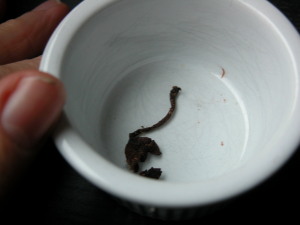
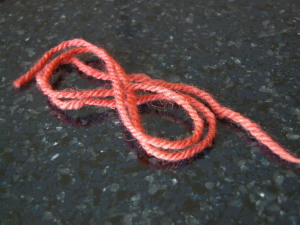
Colour from one sanguineus
Undaunted, I prepared the last mushroom dyepot of the season, and this precious strand of colour will be featured somewhere in the mushroom sweater I’m thinking (and thinking) about.
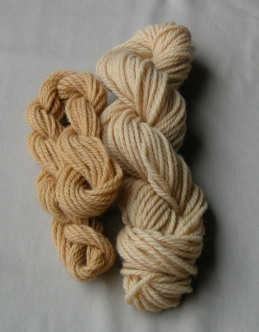
This little fungus caused a fair bit of consternation when I was trying to identify it. It’s soft and bright yellow when young, then as it dries, it hardens and turns bright orange.
I had it pegged as Phaeolus fibrillosus (from Mushrooms Demystified by David Arora), but couldn’t find any images for that one on line. So of course I had to show a dried specimen to David when he stayed with us, and he identified it as Pycnoporellus fulgens . . . formerly known as Phaeolus fibrillosus.
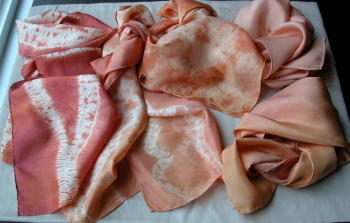
It doesn’t give a strong colour, but the soft peachy hues will act as a lovely neutral with the stronger mushroom colours.
I can’t stop fondling these muted greens that go with all my other mushroom colours. The two on the left were mordanted with alum, the next with iron and the one on the right with copper. Again, I had a high mushroom-to-fibre ratio to get these rich colours.
We used some fresh Velvet Pax (Tapinella atrotomentosa or Paxillus atrotomentosus) for the workshop (see the second image below), then what I had left sat in the freezer for a few weeks. I ended up with a strong concentration of mushrooms, resulting in one of the best browns ever to come out of my dyepots (there’s a hint of purple in that brown – I swear it!). The two brown skeins were mordanted in copper, while the green were mordanted in iron. The small grey skein was mordanted in alum.
After these skeins came out, I put the mushrooms back into the pot and they’ve been brewing on top of the woodstove for a few days. I have high hopes for the second exhaust, but first I need to do some more mordanting.
The small skeins from the workshop obviously came from a weaker dyebath; the mordants are alum, iron and copper.
I found lobster mushrooms (Hypomyces lactifluorum) in such great abundance this year that even after setting aside enough parings to get good colour for the dyeing workshop, I had enough left for a strong dyepot of my own.
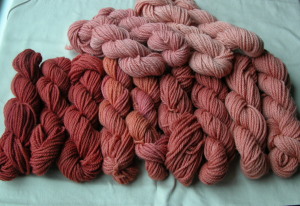
This is the brilliant red that resulted from my first dyebath, while the images below show the exhausts that came out of that same pot – all the skeins, as well as all the scarves.
A hike up Pender Hill yesterday resulted in yet another bag of lobsters, totally unexpected, and even though they’ve gone mushy, I hope to get another dyebath of equal strength.
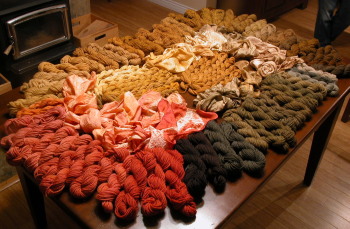
I started gathering up all my skeins and scarves to be tagged for the Fibre Arts Sale this Saturday (an annual event in Sechelt, BC, hosted by the Sunshine Coast Spinners & Weavers Guild) and was surprised to see just how much colour our local mushrooms produced over the last few months.
I’m particularly excited about the reds and pinks from the lobster mushrooms – I filled a yogurt container with the dried parings, tied them up in a bag, and the dyepot is still going! I’ll have photos of all the exhausts once the dyepot is spent, as well as images of some of the other more awesome colours (there’s a deep brown-purple at the bottom right in this image, which should show up better in natural light). As you can see, my colour wheel here is heavy on the golds, browns, and brown-greens, all from the abundant Phaeolus schweinitzii the forest gave me this year. The blobs in the middle are silk scarves – again, I’ll try to show them to better advantage in later posts.
My mushroom paper hat had been sitting on the coffee table, waiting for a new home. And guess what? It’s now gone home with David Arora!
David was our guest speaker at the First Annual Sunshine Coast Mushroom Fest held here in Pender Harbour in October, and he was our guest here during that time.
Photos of lobsters
He stayed on until we had a few days of sunshine (this is the Sunshine Coast, after all!), to take advantage of the light so he could get some mushroom photos. Here he’s found one of our lobster patches.
Lobster mushroom, different pHLobster - Hypomyces lactifluorum
At last I’ve had a chance to take some photos of the finished skeins showing the lovely colours we got from the dyepots at our October 16 workshop.
I usually leave this particular dyepot to the end of the workshop because the colours are so beautiful and the changes so dramatic when you shift the pH by putting the skeins in different afterbaths – in this case, the skein on the left was put into a pH3 solution (water and a bit of vinegar), while the one on the right was soaked in a pH11 solution (water and washing soda). The skein in the middle was left as it was right out of the dyepot.
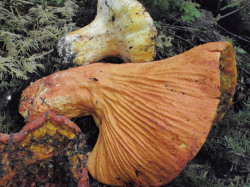
We had an abundance of lobster mushrooms in this area this year. As you can imagine from looking at the image, they aren’t hard to spot when they’re emerging from the moss or the forest duff. I’m just now getting ready to fire up my own dyepots with the lobster parings I’ve been gathering over the past month or two.
Everyone had a great time at our mushroom dyeing workshop here at Bluff Hollow last Friday. Fortunately, the mushrooms have been abundant – after an iffy summer with very little rain – and we had some interesting and productive dyepots.
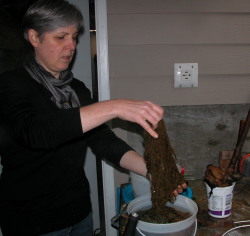
Here Julie is untangling some wool just out of a Phaeolus dyepot – we had enough young ones to give us a strong colour (here mordanted with copper).
Paring the lobsters
Lobster mushrooms (Hypomyces lactifluorum) are exceptionally abundant this year, to the point where I had to carry a good ten pounds of them up a steep hill to get them home one day!
Here a few members of the class are paring off the red “skins” to put in the dyepot – we got some lovely reds out of this one, which you’ll see in the group photo below. I’ll post close-up photos soon.
Silvia, who attended the 2008 Fungi & Fibre Symposium with me, joined us and brought a Boletopsis that she’d kept in the freezer since last year. Sometimes they’ll give a nice green; here we seemed to get a nice grey. Nothing wrong with a good neutral . . .
Look at the colours!
And here are all the marvelous colours we got! Closeups and descriptions of the mushrooms will follow in a couple of weeks (I’m going away, to decompress after the weekend’s fabulous Mushroom Festival – more about that later, too).
Phaeolus just right for dyeingYellow underside of the Phaeolus
I had a fantastic foray a few days ago and came home with a good ten pounds of Phaeolus – even my dog alerted me to a prime specimen (although he hasn’t repeated that trick since).
Here are two views of one that was still yellow and fuzzy on the underside and around the margins, a good sign that it will give some bright colour. I’m saving it and the other young ones I found for the dyeing workshop I’m holding this Friday the 16th (as part of the First Annual Sunshine Coast Mushroom Fest this weekend). I hope a few days of sitting outside won’t have dimmed their potential for lustre!
From the Phaeolus dyepot
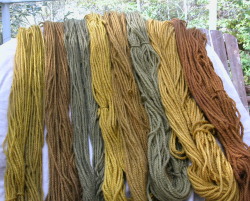
Here are some of the skeins that came out of recent Phaeolus dyepots. I’ve prepared 30-yard skeins (here the gold ones were mordanted in alum, the brown in copper and the greenish ones in iron) so I can get some good colours without exhausting the dyebath in the first go. Now that it’s cold enough to have the wood stove going, I put a new skein in the dyepot in the morning, leave it all day and overnight, then it’s cooled off in the morning. I can go for four or five days with a Phaeolus dyepot before the gold starts to look washed out, at which time the spent dyebath goes on the compost and the mushroom bits go into a bin for future paper-making.
CELEBRATING THE BEAUTY OF SUNSHINE COAST MUSHROOMS




 My mushroom paper hat had been sitting on the coffee table, waiting for a new home. And guess what? It’s now gone home with David Arora!




 SHROOMWORKS