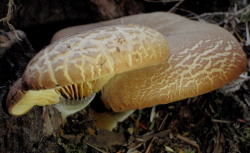
Dyer’s polypore results

Phaeolus buttons1
Colours from fresh Phaeolus

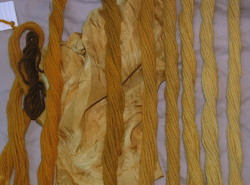
Here are the results from the two smallish, fairly fresh Phaeolus schweinitzii I mentioned in my Sept 3 post. This image doesn’t do justice to the colours – they are actually brighter than they appear here. I used a small dyepot and small skeins, one at a time, and kept the heat on low the whole time. You can see the colours in succession, from left to right. The first two baths gave duller colours (the smaller skein third from the left was mordanted in iron; all the rest were mordanted with alum), but as I did more exhausts, the gold got brighter, than faded to a soft yellow.
Phaeolus buttons, second batch
Phaeolus buttons

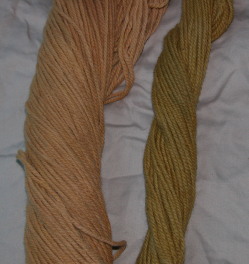
So when I found a group of Phaeolus buttons, still fuzzy yellow and unopened, I decided to repeat the process. Again, the succession of dyebaths goes from left to right, this time with the smaller skein having been mordanted in copper. I dyed a silk scarf in the third dyebath, with beautiful results, and again the successive dyebaths faded to a warm yellow.
Disappointing Phaeolus buttons

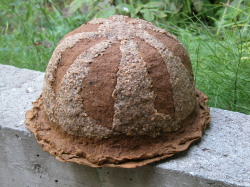
I’d had my eye on a place where I found a large grouping of Phaeolus last year, so when I found them coming out this year at a nice button stage, I went at them with my knife, in great anticipation of their giving the same brilliant gold. I cut them into chunks about two inches wide and ended up with a good two cupsful of mushrooms in my dyepot. Again, I kept the heat low, and in went a large (100g) skein, and look what resulted: a nice mushroom tan! Thinking that this dyebath might behave like my first attempt above, where the colour actually brightened after a couple of tries, I put a copper-mordanted skein in for the second exhaust – and got a dull army blanket green!

I don’t want to discard all those good mushrooms yet (or turn them into paper), but I don’t want to waste any more wool if the colour isn’t going to improve, so I’ve taken a bit of the dyebath and a few pieces of mushroom and put them in my smaller test dyepot with a smaller skein. We’ll see what happens with this.

Blue-staining slippery jack

I might as well be dyeing with slippery jack!

Getting the dyepot ready

First dyer's polypore this year

Our summer has been so very dry this year that I’m not finding too many mushrooms of any kind in the forest out back. I did find a couple of small Phaeolus schweinitzii near a boggy area, and these were already partially dried. I put them in my small dyepot and did a slow almost-simmer for four or five hours, then dyed some sample skeins, which came out a lovely, rich gold. I then returned the pieces of the polypore back to the dyepot for another few hours, and now a second sample dyebath is in the works. I want to see how many of these little dyebaths I can get from the two mushrooms – I’ll have photos up shortly.

All together now . . . rain dance!

Flash!! David Arora coming to Pender Harbour!

I’ve been working with a small group of people who are organizing the first Sunshine Coast Mushroom Fest, to be held here in Madeira Park on October 16-18. As we blue-skied about what we wanted this festival to look like and wondered who we should invite to speak at our first event,  David Arora’s name came up, as in, “Wouldn’t it be great if we could somehow get David Arora up this way to talk to us?”

Well, guess what? David’s driving up from California in October to attend a couple of other mushroom events in these parts, and said he’d be more than happy to take part in our little mushroom celebration. He’ll be speaking the evening of October 17, then taking a limited number of people (thirty) on a foray/ID workshop on Sunday the 18th. Registration will take place through the Iris Griffith Interpretive Centre – I’m not sure when details will be up on their website (www.lagoonsociety.com), but if you can possibly make it here on that weekend, it will be well worth it.

Velvet pax – despite the heat

Tapinella atrotomentosa

We went into the forest on the weekend, not expecting to find anything in the way of fungus (given our current long spell of hot, very, very dry weather), so I was thrilled to find one mossy stump with four of these beauties – Paxillus atrotomentosus, aka Tapinella atrotomentosa) growing out of the wood. I’d found a couple on this same stump last year and expected to find some later in the month, after our usual August rains.

These were clearly drying out – note the cracks on the cap – so I picked them, but left the other button-sized speciments to flesh out a bit.

The other little mushroom I referred to in my last post came out of the freezer this week and is currently sitting in a jar of water in the full sun, and the liquid has turned brown.  I’ll let it cook there until our next rain (please let that be soon!), then see what colour results.

Mushrooms are popping!

Velvet pax1 Aug11_08I’ve found a couple of small Velvet Pax (Paxillus atrotomentosus or Tapinella atrotomentosa) in the forest behind us, one on a mossy stump and one at the base of a dead tree (on which are also growing some varnished conk). I was surprised to find them so early, but apparently the June rains brought them out. They weren’t as large as those in the image here, but they were still unmistakeable, with the brown velvet on their stems and the purplish discoloration where the bugs or squirrels had nibbled at them.

Velvet pax 2009Of course, I had to try the first little specimen (its cap was already cracking) in the dyepot, and here are the results. This is the mushroom that has been known to give a purple colour, but here the alum-mordanted sample (top) has a definite greenish cast, while the iron-mordanted sample below is a nice army-blanket green.
The second mushroom I found is currently sitting in the freezer; I’m wondering if that might make a difference to the colour.

Mushroom Bowler

Mushroom bowlerHere’s a variation on the mushroom bowl: a bowler hat! It’s still sitting on the metal bowl I used as a form, but it should be ready to pop away in a few days. Given the shrinkage rate of this paper, I doubt the hat will fit on my own head, but maybe someone will find it useful.
Mushroom jewelry

Mushroom jewelry
Mushroom jewelry

I’ve been playing with mushroom paper beads lately, as well as using turkey tails for making jewelry – a whole new world, this, but a good way to spend evenings in front of the TV.

Once the beads are dry, I drill holes in them with my Dremel, then string them onto some twine and brush on a few coats of Verathane, for strength and waterproofing. Then they’re ready to use. For the whole turkeytails, I Dremel the top edge so it’s fairly flat, then drill a hole in the top for the wire loops.

All of these pieces will get tossed into the freezer for a few days, just to make sure no little critters remain inside!

More mushroom bowls

Insides of two mushroom bowls
Outsides of same bowls

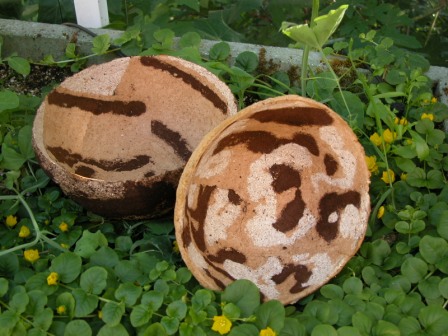
Here are two views of the same bowls. I used a turkey baster to place the different colours on the screens for the paper that was to become the  insides of the bowls, and for the outside textures, just pressed  damp mushroom pulp on the core of each bowl (which was made of  conk pulp). These were molded over glass bowls, on which I’d sprayed some Pam to act as a release. After sitting covered overnight, I put them outside in a shaded area until I could see the pulp wanting to shrink away from the bowl. With a little “nudge” from a knife blade, they popped right off. To keep them from warping, though, I left them sitting on the glass bowls until they were thoroughly dry.

Mushroom bowls

Conk
Conk

It’s been too long since my last post. Papermaking mushrooms can be found year-round, so I’ve been collecting and processing them, then when time allows, I can continue to play with papermaking.

This is a conk – Fomitopsis pinicola – mentioned in an earlier post as the one that makes the strongest paper and which I use as a base when making mushroom bowls.

Sometimes its appearance is paler, as shown here. I like to find them when they’re very young – they’re white and look like little marshmallows growing on the side of a tree or log. I keep track of these  “nurse trees” in my internal GPS – I may have trouble remembering things, but my brain has imprinted the locations of special mushrooms!

Mushroom Paper

Now that it’s warm enough to go without a fire in the woodstove for most of the day, I’m waiting for a good time to fire up my outdoor burner and see if there’s any colour left in the dyebaths from the November dye workshop.

With the mushroom dyeing season almost over, it’s time to get going on some more mushroom paper. Yes! – certain mushrooms can be processed into paper. (Or, to be technically correct, “paper-like sheets,” as apparently only paper processed from materials containing lignin can properly be called paper. But I’m going to call mushroom paper “paper,” because that’s how I think of it.)

To make mushroom paper, I use conk (Fotimopsis pinicola), dyer’s polypore (Phaeolus schweinitzii), and turkey tails (Trametes versicolor).

Mushroom paper bowls

Here are some bowls I’ve made recently. Of the three mushrooms I use, conks make the strongest and most resilient paper, so that’s the tan base material in each of these bowls. I used a turkey baster to create the dark brown designs on the inside – that’s from dyer’s polypore (after I’ve used it to dye fibre, of course). The textured band on the bowl on the left is from the turkey tails. I do like the texture of turkey-tail paper, and I’m working on a way to make it less brittle – by adding a quantity of jelly fungus. I’ll have more to say about that in a later post.

Turkey Tails
Turkey Tails
I don’t have any good photos yet of a conk. Here’s an image of turkey tails (you’ll find an image of a young dyer’s polypore in my December 14 post). Turkey tails live up to their name – the “fans” that grow in tiers have subtle stripes in shades of brown, grey, or orange. They’re so ubiquitous they’re considered the crabgrass of the mushroom world, so they’re easy to find.

To make paper, the mushrooms have to be cut into small pieces and run through a blender with water until you get a pulp of the right consistency. After dyeing with the dyer’s polypore, the mushrooms will be in crumbly chunks that can be liquefied very easily. Turkey tails, after a bit of soaking, can be cut with scissors, then blended. Conks, on the other hand, have to be soaked until soft and rubbery – sometimes this takes months!

Once I have a nice pulp, I use standard papermaking screens to make thin sheets that can then be dried flat or molded to a shape. (I won’t go into the entire papermaking process here, but I’m going to have a workshop on April 26 for those who are interested in learning it.)

CELEBRATING THE BEAUTY OF SUNSHINE COAST MUSHROOMS