
All posts by Shroomworks
Six shades of . . . purple
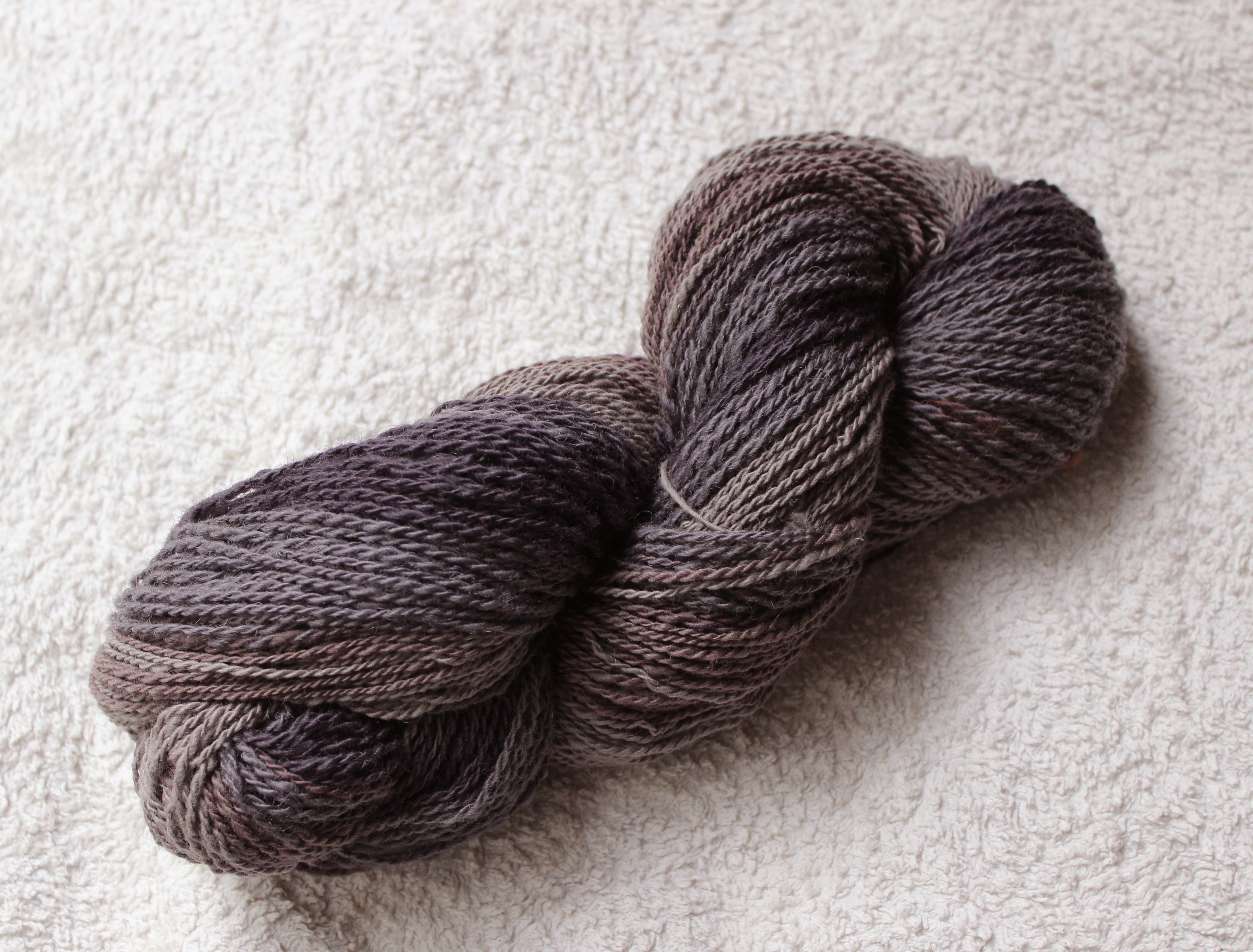 When I sat down to spin the lovely Omphalotis purple, I decided to keep separate the six different shades that emerged from successive exhausts of the same dyepot. So I split the wool of each shade in two and, working from darkest to lightest, spun two plies of about the same length and with the same gradations of colour. These I plied together into one skein.
As these special colours flowed through my hands and onto the bobbin, I realized that I’d put two different types of wool into the dyepots, one a bit coarser than the other. Not to worry—whatever I make with this will be for myself, and with sich royal hues upon my person, what possible complaints could I have?
Camisole in red
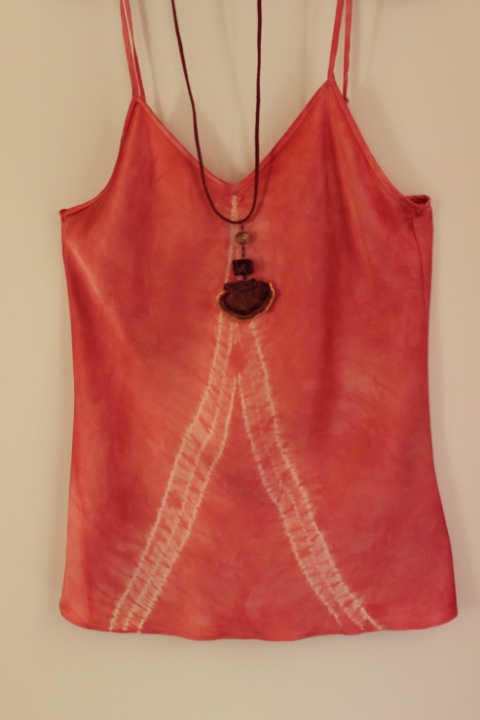
Last season was a poor one for the dermocybes, so I saved up what I had collected until I could decide what to do with them. I’ve been playing with silk lately and thought perhaps a camisole would be just the right garment for a good dermocybe red.
I used three rows of stitching for each line that goes from neck to hem, and repeated that design on the back. The dyepot was concentrated and gave me the colour I was hoping for, and it dyed a few more ounces of wool before the colour was exhausted.
Unfortunately for me, the silk camisoles I’m using, supplied by the good people at Dharma Trading, are manufactured in Asia, and therefore come in Asian sizes, meaning that a camisole labelled XL is equivalent to a North American M.
Fortunately for the lady who saw this garment hanging in our booth at a recent craft sale (and whose first comments were, “I’ve already spent enough today [spies the camisole] . . . Omigod!”), it fit her perfectly and looked absolutely stunning. I’m glad it’s gone to a good home.
Spinning Omphalotus

After the usual seasonal hiatus, when mushrooms lie dormant and the garden takes priority, I’m back to dreaming of mushroom dyepots and all the potential therein: I’ve found the first early dye mushrooms in the back forest! More about those later, but for now I’ve started spinning the gorgeous violets I obtained from the Omphalotus olivascens (see my post of May 12). With a bit of experimenting, I’ve discovered that a mild vinegar rinse (pH3) seems to set the colour—rinsing in plain well water took some of the violet out and left a grey, and a rinse in pH9 did even moreso (good thing I tried it with just a small sample.)
I haven’t yet rinsed any of this dyed wool—I’ll spin them first, then set colour and twist at the same time.
I’ve taken each piece of dyed roving and divided it in half, spinning from darkest to lightest (the colours each successive exhaust dyepot gave me). I’ll spin two bobbins in this way, then ply them together, with the end result being one yarn that starts with the lovely dark violet and ends with the lightest purple-grey. In time, I’ll turn this into a scarf or a shawl, depending upon how much I end up with.
Yet another Aaaargh! moment
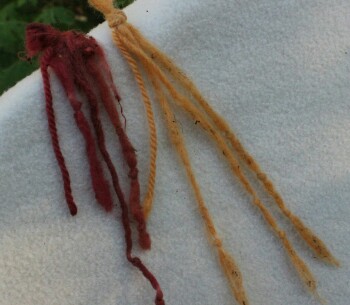
This has been a week of surprises from the dyepots, and surprises are good, right? They keep us on our toes, right? It’s just that, well, why did the surprise have to occur with my lobster mushrooms?
The last two years were not conducive to lobsters (Hypomyces lactifluorum), with prolonged dry spells and later than usual autumn rains. Added to that, three of my prime lobster patches—three!—were smack in the middle of the logging road when part of our backyard forest was clearcut three years ago.
I use just the outer orange parings of these mushrooms for dyeing, as the inner flesh is white and will simply absorb the pigment (plus, it’s good to eat if you know which mushroom has played host to the parasitical Hypomyces). So I saved up the parings from the three or four stunted specimens I found in the fall, then was overjoyed to find a paper bag of more parings that I’d evidently tucked away a few years ago. This was going to be one very special dyepot!
Indeed, the dyebath turned a beautiful orange-red within minutes of starting to simmer, and my sample yarns turned just the colour I wanted. I planned to dye a silk scarf that had taken me hours to stitch a complicated shibori design into, but I hadn’t yet mordanted many of my silks . . . never mind, thought I, I’ll just add some alum to the dyepot.
Note to self: take the time to pre-mordant, even if you don’t think you have the time for it.
I measured out a couple of spoonsful of alum, dissolved it in boiling water, then added it to the dyebath. And then . . . another moment of helpless, hyperventilating horror as I watched the red disappear before my very eyes! Thankfully I’d already removed the first sample strands (so at least I know what I missed out on) and hadn’t added the shibori scarf; a second set of samples turned out to be a lovely peach, with little distinguishable difference from one mordant to the next. (My samples are: no mordant, alum, iron, and copper.)
So now I have two silk scrunchies in a lovely peach (after which the dyepot was exhausted) and a hard-earned lesson to apply to this year’s certain (I remain optimistic) bumper harvest of lobsters.
In the meantime, I’m still looking for any chemists out there who can tell me what happened!
Now this is violet!

After my first Omphalotus dyepot, which I’d done with our well water and which gave me mostly very nice greens, (see my post of April 18) I decided to use distilled water for my second (and last) dyepot. When the dyebath was almost at temperature (about 170 degrees F), I saw that my sample strands showed signs of violet, so I put my first piece of undyed wool in right away and left it for about 20 minutes, by which time it too was violet.
(I should mention that I generally leave the mushrooms to simmer in the dyepot while I do the exhausts, in case I can wring out a bit more pigment. I’ve discovered Tide lingerie bags—and no, this is not a product placement for any particular brand—which are made of the finest mesh, with a zippered closure. Using this, I can lift all the fibre out in one go, and I don’t have to deal with any leftover mushroom bits.)
I pulled the fibre out immediately, fearing that this colour might get dull if left to cook too long. After it had cooled, and without realizing what I was doing, I put the fibre into a bucket of (well) water and watched, in absolute horror, as the violet disappeared before my very eyes! The wool was a lovely steel grey, but grey was not what I was after.
I immediately put another piece of fibre into the pot, watched it carefully, and pulled it out when it was clearly going to be violet. This time I didn’t rinse it, and the colour remained. In fact, I got several more exhausts from this dyepot, the violets becoming progressively lighter, but definitely violet. I stopped when my last sample came out an undistinctive beige.
After the wool had dried, I rinsed a small sample in well water and another sample in a vinegar rinse—their colour doesn’t seem to have changed, but I’m nervous about rinsing the rest of the wool until I’m certain it’s safe to do so. Our well water tests high in calcium and silica, with a pH of 7.6—any chemists out there who can explain what’s going on?
Old Gold
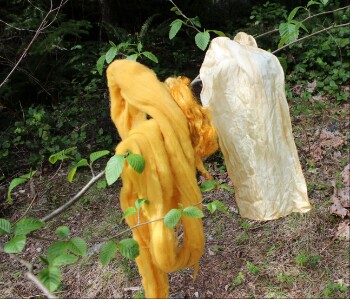
I realize now just how blessed I’ve been in recent years to have such an abundant supply of Dyer’s Polypore (Phaeolus schweinitzii) in my backyard forest. This year, for a number of reasons, I was unable to process much of this wonderful fungus when it was fresh; I had to leave most of it to dry, and I’m now working my way through it.
My first discovery has been that the colour isn’t as bright with the dried mushrooms as when they’re fresh, although this dyepot would contradict that finding. This is one of the more brilliant golds I’ve ever had, and I know there was one smaller Phaeolus in the pot that had been picked fresh. It was still coming out of its button stage, and the inner flesh, when I cut it into chunks, showed some promising colour. However—and this is where I’ve been blessed, or some would say spoiled—one dyepot was all I got. The silk scarf on the right also went into this bath, scrunched down and tied around a wine bottle, and the colour barely registered.
Also, I’m having to use more mushrooms per dyepot, four or five dried mushrooms versus one or two fresh. I tried boiling up this dyepot again, with just the mushrooms and no fibre in the pot, to see if I could squeeze out a bit more gold, but to no avail—my samples came out a tired tan.
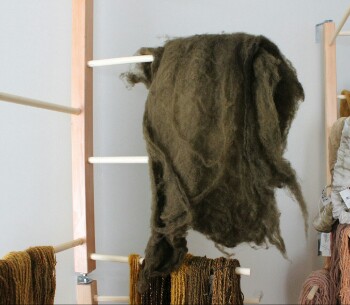
But never mind—while moving buckets and things up to my studio, I came across this batt of Corriedale, which did go through a fresh Phaeolus dyepot last fall and came out a beautiful, deep green. It had been mordanted with iron, and after several rinsings to remove any traces of the mordant, I left it in a bucket of water and promptly forgot about it. What a bonus find! I think this will card up nicely with some of the less striking golds and browns, and I should have a nice tweedy yarn in the end.
Omphalotus olivascens
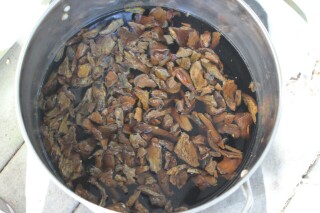
I was fortunate enough to obtain a quantity of these mushrooms (dried) from the amazing Alissa Allen (see mycopigments link at the side), who’d collected them in December around Arcata, California. I was swooning in anticipation, because these beauties are purported to give a violet colour, and they don’t grow this far north. So here they are, having soaked overnight in my well water, ready to be cooked up.
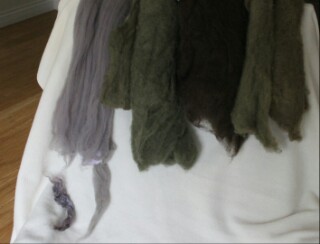
Here, then, the results, from left to right: First dyepot, unmordanted wool; first dyepot, mordanted with iron; second dyepot, mordanted with iron; third dyepot, mordanted with copper; fourth dyepot, mordanted with iron; fourth dyepot, mordanted with copper.
As an experiment, I took a bit of wool from the first violet sample and placed it in an ammonia solution (pH9) to see if that might bring out even more of the violet. To my dismay, the sample (seen at the left, under the first violet sample) quickly turned grey. A striking grey, but grey nonetheless. Next to that grey sample is a bit of synthetic “icicle” that picked up the violet colour without a problem.
Being unwilling to let go of this potential colour, I tried yet another exhaust with my little samples, but it was clear the pot had nothing more to give than an uninteresting beige, so I was forced to return what was left back to the forest.
This has been a very exciting dyepot, and I still have half ot the dried Omphalotus to play with again!
Hydnellum green
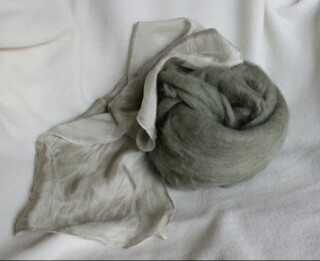
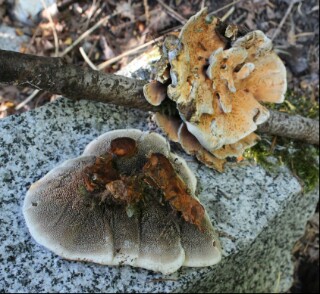
My first dyepot after a long winter hiatus! I was trying for blue, using a good lot of Hydnellum aurantiacum and following directions provided by my mushroom dye mentor, Susan Hopkins.
I broke the dried fungus into small pieces, soaked them overnight in plain water, then the next day brought them up to ~170-180 degrees F and held that for an hour. The fibre and silk went into the dyepot the next day, when I added enough ammonia (neither sudsy nor flavoured) to raise the pH to 9. Another hour at the same not-quite-boiling temperature, and I was hoping beyond hope to see the lovely blues that are possible from this toothed fungus.
The one thing I didn’t do: I didn’t use distilled water. Our own well water is neutral in almost every way, except that it’s high in calcium. I wonder if that might have made the difference.
I won’t say I’m disappointed with this soft sage green, because I’m not, and I have another variety of Hydnellum yet to try—hope springs eternal!
My New Haven
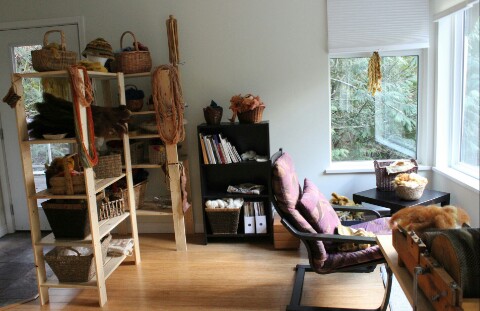
After months of planning, preparation, painting, and moving, my new space is officially open and ready to accommodate this mushroom person. The most stressful part of the whole transition was having to sort through all the fibre I’d accumulated in the eight years since I started spinning. As any fibre person will attest, a stash is not a static thing—it reproduces in the dark, silent hours, apparently exponentially, until it has occupied space in every room of the house. (Yes, even our guest bathroom had fleece spread out to dry on the floor.)
This turned out to be an exercise in cleansing and purging, as I realized I have no space in my life for unwashed fleece filled with VM (short for vegetable matter) or the leftover bits and pieces of commercially dyed wool that might have one day gone into the making of something interesting but will be put to better use by my grateful fellow Guild members.
Already, after just a week of gloriously peaceful afternoons spent in my little cottage (formerly our B&B cabin), I can see the huge difference it makes to have everything at hand, especially when that everything doesn’t have to be put away at the end of the day.
In honour of my mom, who created her own little contemplation room she called My Blue Haven, I’m calling this My New Haven, a space I feel truly blessed to have.
 SHROOMWORKS