Category Archives: Mushroom dyeing

Results of dyeing fibre with mushrooms I’ve found in the surrounding rainforest

Study in purple

Orange coral
Ramaria largentii

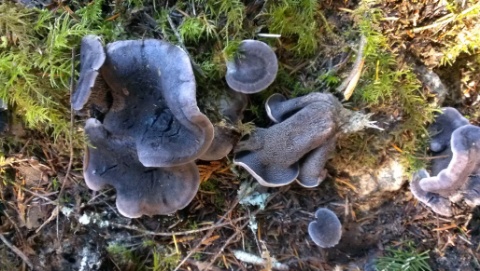
“Study” implies lessons to be learned, and that’s certainly the case with this mushroom, an orange or pink coral (Ramaria gelatinosa).

When I first started playing with mushroom dyes, I’d read that this one would give purple if an iron mordant was used, so I popped a good handful of the mushroom into my little sample dyepot, along with my mordanted samples, and boiled the life out of it, only to find an interesting grey at the end of the process. I even blogged about it at the time. Despite my suggestion then that I’d try that one again the following year, there were so many more mushrooms to try that I walked on by the orange/pink coral . . . until this year.

The forest provided such an abundance of this coral mushroom this year, along with everything else, that I decided to collect what I could and try again. But since I was spending every available minute out collecting all kinds of mushrooms, I did with the coral what I did with all my other treasures: I spread it out on newspapers to dry.
ramaria samples burgundy_120

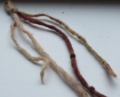
When it was time to fire up the sample dyepot again, I’d just brought in some more fresh coral, so that went in first, and I used a splash of ammonia to raise the pH of the dyebath to around 10—and the iron sample yarn came out a deep burgundy. (The samples, left to right: no mordant, alum, iron, copper.)
dried ramaria samples_120

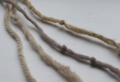
Energized by this result, I tried another sample pot with a handful of dried coral (of which I had mountains by this time) . . . which resulted in an insipid grey. The mountains of dried coral went back to the forest, my gift to the mushroom fairies. Another lesson learned.

Ramaria colours_120

I had enough fresh coral left for a good-sized dyepot, from which I got these colours on some Corriedale batts.

As luck would have it, I found another good clump of coral a week or so later; it stayed outside in a paper bag, and by the time I got to it, it had frozen solid. Into the dyepot it went (again with ammonia to raise the pH), along with some premordanted (with iron) silk: a camisole, a scarf, and a silk “hankie,” which will be spun into a fine thread. I took to this dyepot some lessons already given to me by two of my dyeing mentors: when trying for purple, don’t let the temperature of the dyebath rise much above 160 degrees F, and pull it out of the dyebath as soon as you have the desired colour (as opposed to leaving the fibre to soak overnight or longer). And here’s what resulted:

Purple from orange coral
Purple from orange coral (Ramaria)

I’m thrilled, of course, although the last lesson from this mushroom is the hardest to deal with: patience. I have no more Ramaria to play with this year—but that makes this purple all the more special, doesn’t it?

Is this blue, or is this blue?

Blue from Sarcodon fuscoindicus - Violet hedgehog
Blue from Sarcodon fuscoindicus – Violet hedgehog

A couple of months ago, I rhapsodized about finding an unexpected treasure, an embarrassment of richesSarcodon fuscoindicus, or Violet hedgehog. A few weeks after that post, my dearest went out to the same spot and picked the buttons I’d left behind, resulting in about twenty pounds—twenty pounds!—of the fresh lovelies. I had no choice but to let them dry, given the bounteous mushroom season that required daily harvesting, so I only just got my dyepots fired up in earnest this week. And I couldn’t resist—I had to go for the blue first!

I selected five dried hedgehogs, broke them into pieces, and put them into a stainless steel bowl, to which I added water and enough ammonia to bring the pH up to 10. The mushrooms soaked there for several days, after which I poured off about half the liquid into a medium-sized dyepot. I’d already done a sample run, which revealed that fibre pre-mordanted with alum was most likely to pick up blue, so to the dyepot I added a good hunk of alum-mordanted wool roving and a piece of silk.

I brought the temperature up slowly, all the while half holding my breath, because nothing seemed to be happening: all I could see was a dingy grey. Then, as the temperature rose to 160, then 170 degrees F, I noticed some blue in the wool as I raised it out of the water with a plastic spoon. At 175 degrees, I decided it was time to pull the fibre out. I carried the hot wool to the bathtub (my studio used to be a B&B cottage), where I draped it over the edge of a large plastic bucket, to cool without rinsing.

The silk (the little curl in front of the wool roving) seemed to pick up the colour more quickly and with more intensity than did the wool, so my next dyepot will involve some silk garments. In the meantime, the exhaust of this first dyepot now contains some more wool— I ran out of time to bring it up to the full temperature, so I’ve left it overnight and will see if the mushrooms still had any magic to give.

More and more, thoughts of witchcraft are entering my mind—cauldrons, magic, obsessions . . .

The Intervention

Ann . . .

I prefer to be called Mushroom Annie.

Alright, then—Mushroom Annie, we’re here today to discuss a matter of serious concern that has come to our attention.

Go ahead. But please make it quick. A cold front is coming in next week, signalling the approaching end of mushroom season.

Uh, yes . . . I see that you understand already.

Understand what?

Your family and friends are worried about you. Your studio floor is covered with drying fungi, your dehydrator is churning out dried fungi, your front steps are littered with all manner of disgusting fungi, yet you persist in going out every day for more mushrooms. Does this not seem a touch worrisome?

Not at all. Why should it?

Well, for one thing, what about your friends? Are you not concerned that you might be neglecting them?

I have friends in my mushroom club, the Sunshine Coast Society for the Hunting, Recognition and Observation of Mushrooms (that’s SHROOM for short). Silas, my dog who accompanies me on all my forays, is my good friend. Even the forest fungi are my friends.

Listen, Ann . . . I mean Mushroom . . . oh, dammit, you know who I mean! You’re obsessed! You’re living a one-track life! You’ve allowed mushrooms to assume an importance beyond their worth! I’ve learned that you’re not even spinning in the evenings anymore! That time in front of your spinning wheel used to be sacrosanct—can’t you see what’s happening to you?

I miss spinning, I really do. But I keep finding Lobster mushrooms, and people keep giving me more, and they have to be pared before they go rotten. And speaking of Lobsters, I’ve already made concessions. My husband banned me from cooking the parings inside, because it made the house smell like, well, rotten lobsters. That was a major factor in my decision to turn our guest cottage into a mushroom studio.

You gave up B&B-ing in favour of mushrooms? This is more dire than I thought. How have you let it come to this?

All I can say is . . . well, consider my latest foray into what I call my backyard: acres and acres of forest where Silas and I can hike for hours without any human contact.

Do tell.

At the start of the trail was this intriguing photo op—how could I pass it up? And it’s a dyer—a bonus!

Sulfur tuft flowers
Sulfur tuft flowers

Once we reached the day’s foraging spot, as I clambered over logs and squeezed under deadfall in search of Dermocybes, I saw this Lobster peeking through the duff, tantalizing me to inspect a bit closer. I picked it, of course, and looked around carefully, only to find five more of these beauties, all ready to offer up their pigment. Do you know how hard it is to obtain red from natural dye sources?

Hint of lobster
Hint of lobster

And all this before I reached my goal: Dermocybes! The satiny finish! The scarlet gills! The siren song! Irresistible.

Red-gilled Dermocybe

I’ll admit to a surfeit of Dyer’s Polypore, but this little one was exhibiting such generosity! I’d already cut it back to the ground a couple of weeks earlier, and here it was, creating yet more opportunity, just asking for another chance to give of itself. I couldn’t bear to disappoint it now, could I?

Phaeolus schweinitzii, second growth

That’s all very well, but if you must look for mushrooms, have you never thought about turning your attention to something useful? I’m talking about the ones chefs covet, the ones foodies rhapsodize about.

I have nothing further to say.

Matsutake
Matsutake

Riches . . . embarrassment

Violet hedgehog
Violet hedgehog

Now I understand the meaning of the term, “embarrassment of riches.” Everyone’s talking about the abundance of mushrooms of all kinds this year, and we can certainly attest to that: our dehydrator is going non-stop, I have drying mushrooms spread all over my studio floor, and we continue to come home with piles of mushrooms after every hike in the forest. And the season isn’t over yet!

Sarcodon fuscoindicus

And this one—Sarcodon fuscoindicus, or Violet hedgehog—is a perfect example. Two years ago I was thrilled to find two or three specimens; last year I went back to the same spot and found none; this year I came home with 16 (yes, that’s one-six) pounds of them!

They weren’t all this size—in fact, I left quite a few buttons in case I get back to that area again—but I can’t wait to see what they do in the dyepot!

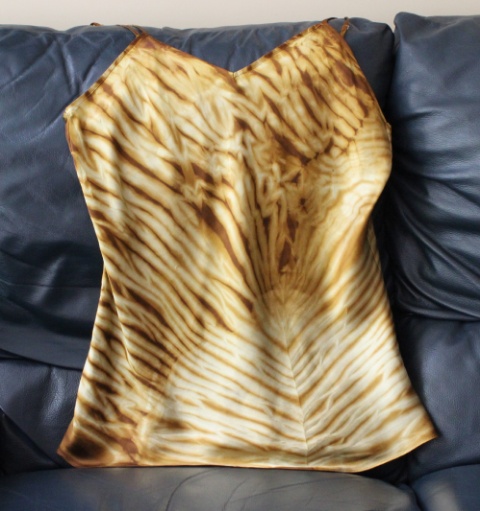
Dyer’s polypore + camisole = wow!

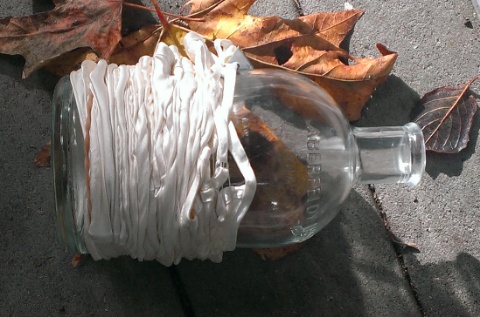
Most of my available mushroom time this season is being spent out in the forest, searching for—and finding—dye mushrooms. But I did put together one Phaeolus dyepot, just to get back into the groove and limber up the senses. I’ve tried “bottle shibori” with scarves before, so this year I decided to try the technique on a silk camisole. I found a suitable bottle (emptied of its original contents, Peat Project scotch, highly recommended) and wrapped the camisole diagonally, starting at the bottom of the bottle. I followed the silk with wrappings of dental floss, spacing it fairly tightly and scrunching it down toward the bottom of the bottle until the entire camisole was tied on. 

Bottle-tied shibori

I like this short, stout bottle because when I stood it upright in the dyebath (having filled it with plain water for stability), the camisole was completely submerged. After a good simmer in the rich colour of a few fresh buttons, I removed the bottle and immediately painted the outer folds with a concentrated copper solution.

camisole post dyeing

I might have removed the camisole as soon as the silk was cool, but the forest called out to me, repeatedly, and it was several days before I could return to this project. I wasn’t sure what to expect, and it took a few minutes to cut away the tightly wrapped dental floss (which had dyed a toothsome shade of yellow). Here’s what emerged:

bottle tied camisole

I only wish the camisole was of a size I could wear!

A bun dance of lobsters!

lobster-parings

At last, a grand year for Hypomyces lactifluorum! We’re finding them in all the old locations (some of which had been bereft of lobsters since 2009) and in some new spots as well. And members of the Sunshine Coast SHROOM have been more than generous in sharing some of their finds, so we’re assured of having some brilliant dyepots at our forthcoming Mushroom Festival and show on October 19

It’s taken me several evenings to pare off the orange “skins” from several bags’ worth of these wonderful fungi, and here they are, spread out to dry in my studio, youngest to oldest, left to right. As they dry, the ones that were wet and soggy at picking have developed an even richer colour, promising some exciting results. I do notice a peculiar aroma on entering the space, but I consider that just one of the hazards of the job.

And the season has only just begun!

Six shades of . . . purple

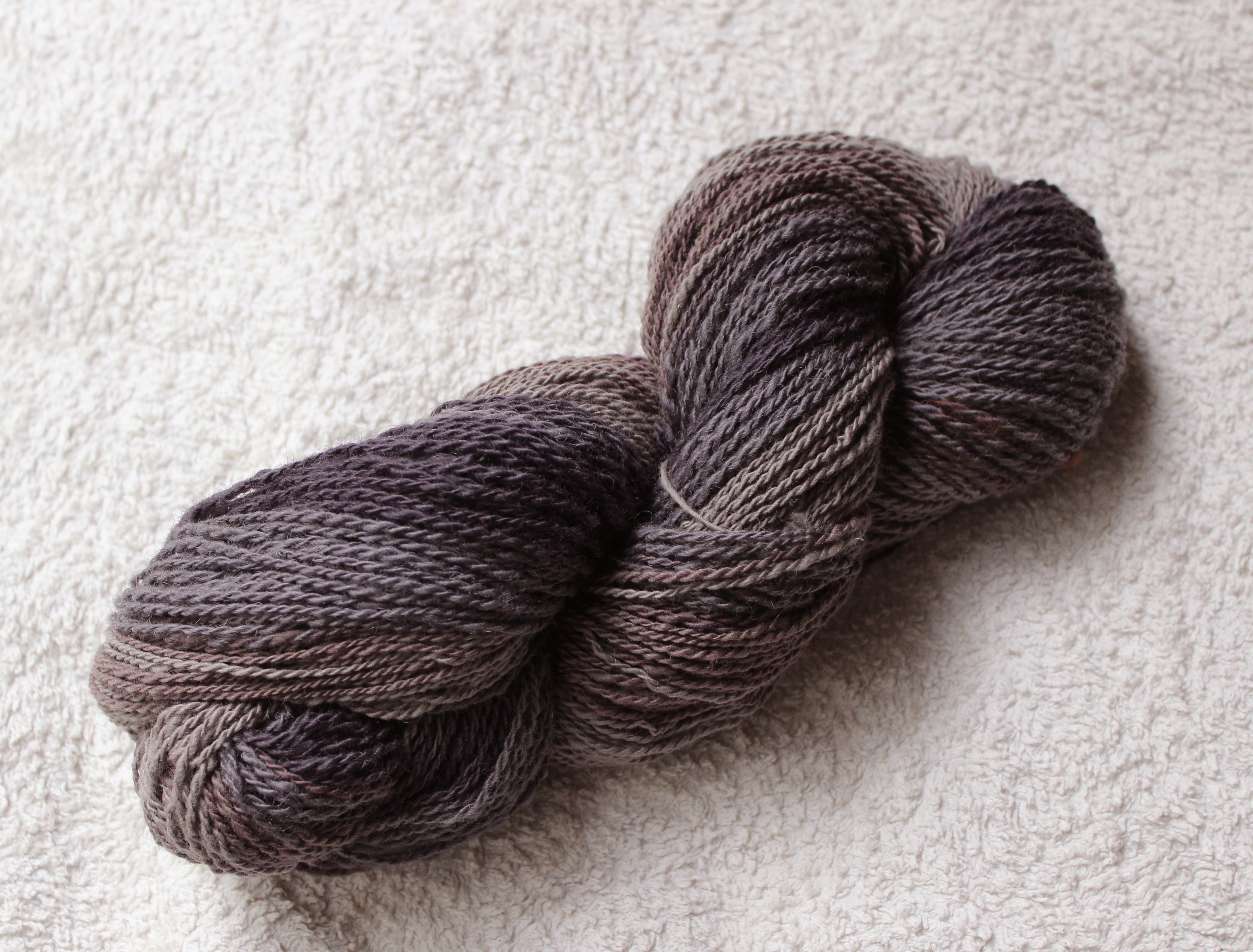
Omphalotus yarnWhen I sat down to spin the lovely Omphalotis purple, I decided to keep separate the six different shades that emerged from successive exhausts of the same dyepot. So I split the wool of each shade in two and, working from darkest to lightest, spun two plies of about the same length and with the same gradations of colour. These I plied together into one skein.

As these special colours flowed through my hands and onto the bobbin, I realized that I’d put two different types of wool into the dyepots, one a bit coarser than the other. Not to worry—whatever I make with this will be for myself, and with sich royal hues upon my person, what possible complaints could I have?

Camisole in red

Mushroom-dyed camisole

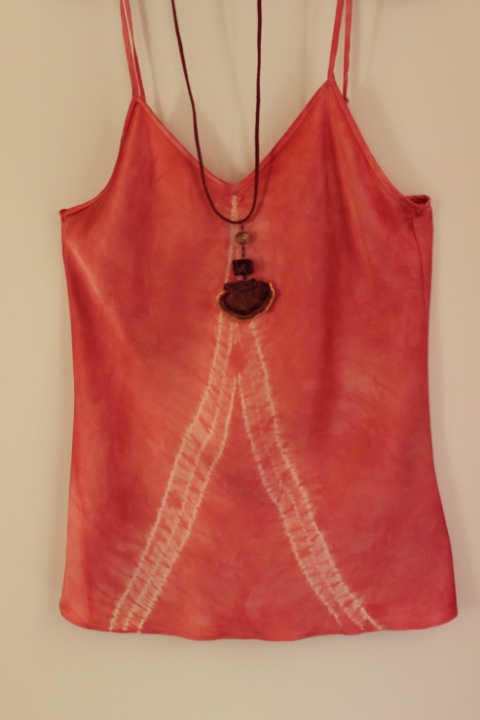
Last season was a poor one for the dermocybes, so I saved up what I had collected until I could decide what to do with them. I’ve been playing with silk lately and thought perhaps a camisole would be just the right garment for a good dermocybe red.

I used three rows of stitching for each line that goes from neck to hem, and repeated that design on the back. The dyepot was concentrated and gave me the colour I was hoping for, and it dyed a few more ounces of wool before the colour was exhausted.

Unfortunately for me, the silk camisoles I’m using, supplied by the good people at Dharma Trading, are manufactured in Asia, and therefore come in Asian sizes, meaning that a camisole labelled XL is equivalent to a North American M.

Fortunately for the lady who saw this garment hanging in our booth at a recent craft sale (and whose first comments were, “I’ve already spent enough today [spies the camisole] . . . Omigod!”), it fit her perfectly and looked absolutely stunning. I’m glad it’s gone to a good home.

Spinning Omphalotus

Omphalotus_spinning

After the usual seasonal hiatus, when mushrooms lie dormant and the garden takes priority, I’m back to dreaming of mushroom dyepots and all the potential therein: I’ve found the first early dye mushrooms in the back forest! More about those later, but for now I’ve started spinning the gorgeous violets I obtained from the Omphalotus olivascens (see my post of May 12). With a bit of experimenting, I’ve discovered that a mild vinegar rinse (pH3) seems to set the colour—rinsing in plain well water took some of the violet out and left a grey, and a rinse in pH9 did even moreso (good thing I tried it with just a small sample.)

I haven’t yet rinsed any of this dyed wool—I’ll spin them first, then set colour and twist at the same time.

I’ve taken each piece of dyed roving and divided it in half, spinning from darkest to lightest (the colours each successive exhaust dyepot gave me). I’ll spin two bobbins in this way, then ply them together, with the end result being one yarn that starts with the lovely dark violet and ends with the lightest purple-grey. In time, I’ll turn this into a scarf or a shawl, depending upon how much I end up with.