This is made with the wool that went through my Cortinarius sanguineus dyepot—the small wine-coloured mushrooms that pack such powerful colour (see my post of February 9). Any dyed wool, once it’s spun, will lose some of its colour intensity, so I didn’t expect this to work up in the bright red I started with. Nevertheless, I’m pleased with the results.
I spun this Merino more tightly than I’d planned to, so after it was chain-plied, the three-ply yarn felt more like a soft cord. I decided to do some improv crocheting and ended up with this very long scarf-like garment that wraps around my neck three times, with lots left over to play with.
While my dyepots are finished for this season, the spinning continues. I’m working on the merino from the multiple exhausts of the beautiful little Cortinarius sanguineus—all the mushrooms went in at once, and I put the wool through successive dyepots until the colour was more or less gone (see my post of February 9). I’ll have four good bobbins of singles, which I plan to then chain-ply, or Navajo ply, which will result in a three-ply yarn without any waste.
Because I plan to crochet with this yarn, I’m spinning the singles in a counterclockwise direction, to be plied clockwise. I have no idea how many yards I’ll end up with, but because I want to make a shawl with it, I’ll choose a pattern that will allow me to continue until I run out of yarn.
This was one of the more fun yarns I’ve spun recently—I combined on my drumcarder several colours that resulted from my various Dyer’s Polypore (Phaeolus schweinitzii) dyepots over the season (samples are taped to the white paper). Then as I spun, I added bits of “icicle,” a shiny synthetic fibre that really pops the colour, to give the yarn a bit of glint. It doesn’t show up that well in the photos, but it’s just enough to add some sparkle.
The wool is all merino, leaving the two-ply yarn with a lovely, soft hand. Another skein to fondle!
I saved the best for last—my collection of dried Cortinarius sanguineus, which didn’t look like much on the face of it, but look at all the colour they gave me! I put all the dry mushrooms into an old stocking, boiled it up for a couple of hours, then left that in the dyepot for all the exhausts. The first dyebath is on the left (with one iron-mordanted roving—the darker one), and progressive exhausts go from left to right. The bright orange on the far left is “icicle,” a sparkly synthetic fibre that always picks up amazing colour.
I’m going to use this to spin one yarn, going from darker to lighter—this mushroom is too special to blend it with anything else.
Moving on from the seemingly non-stop gold dyepots, I’ve now finished dyeing with all the Velvet Pax (Tapinella atrotomentosa) that I’ve been saving and drying since the summer. For this dyepot, I used equal weights of dried mushroom and fibre—330 grams of each—and dyed half the fibre at a time. The dark green roving on the right was mordanted in iron. (Note to self: next year, premordant more wool with iron, to get more dark green!). It’s interesting how the “Icicle” on the left picked up golden tones, while the Tencel (the shiny brown at the top and the shiny beige to its left) picked up the browns.
I probably could have done one more exhaust from this pot, but to be frank, I’m tired of the browns, especially when I all my lovely dermocybes are waiting for me to do something with them.
I learned this year that Chroogomphus tomentosus (Woolly Pine Spike) is edible, but I also heard it might serve as a passable dye mushroom, so my dyepot got first dibs. This is what resulted: a pink with insufficient intensity (considering how many mushrooms went into the dyepot) to make me want to use it again. The small piece of wool on the left was the sample that went through the initial boiling of the mushrooms; the roving on the right, which went into the pot after I strained out the mushrooms, picked up much less colour.
Next year I’ll give them to the chef (my dearest) and see if they might have more magic in the cookpot!
My Phaeolus dyepots are all done now, so while I move on to the mushrooms that have been drying for the last few months, I’m spending my evenings spinning these beautiful gold fibres.
Merino, llama
I dyed some llama rovings in a Phaeolus dyepot (the three strands of fibre on the right—mordanted in copper, iron and alum, left to right)—and I love the gentle way they picked up the colour.
2 plies llama, 1 ply merino
The llama was beautiful to spin, but very slippery. I blended the three hues into one yarn, then used two plies of that with one ply of thick-and-thin merino, to give the final yarn some body. This skein feels lovely and soft.
2 plies merino
Then I carded together several shades (in merino) and got an interesting heather effect.
Mohair encased in merino
I also had some mohair locks that just soaked up the brilliant gold. I cut these into manageable bits, which I encased between plies of the merino. Unfortunately, it didn’t go very far—next year I’ll have to dye much more than a couple of handfuls—but this little skein is magic and would be good to use in combination with the merino yarn.
When I lifted the lid from my Crockpot the other day and saw these samples, my knees turned to jelly and I almost swooned from the enormity of what was before my eyes: blue yarn! From mushrooms I found myself! Here on the Coast!
Sarcodon fuscoindicus
I’d found a group of these Violet Hedgehogs a few weeks earlier, but picked only the two larger ones, thinking I’d give the little buttons a week or two to grow. But on my return to the hallowed spot, they were nowhere to be seen. Either someone else found them, or I’d returned to the wrong hallowed spot.
Nevertheless, I knew I had Sarcodon fuscoindicus, also known as Hydnum fuscoindicum. (I wondered how I’d ever remember the Latin name until I looked up the components—fusco- means dark, while indic- pertains to indigo. As long as I can come up with fusco, the rest falls into place.)
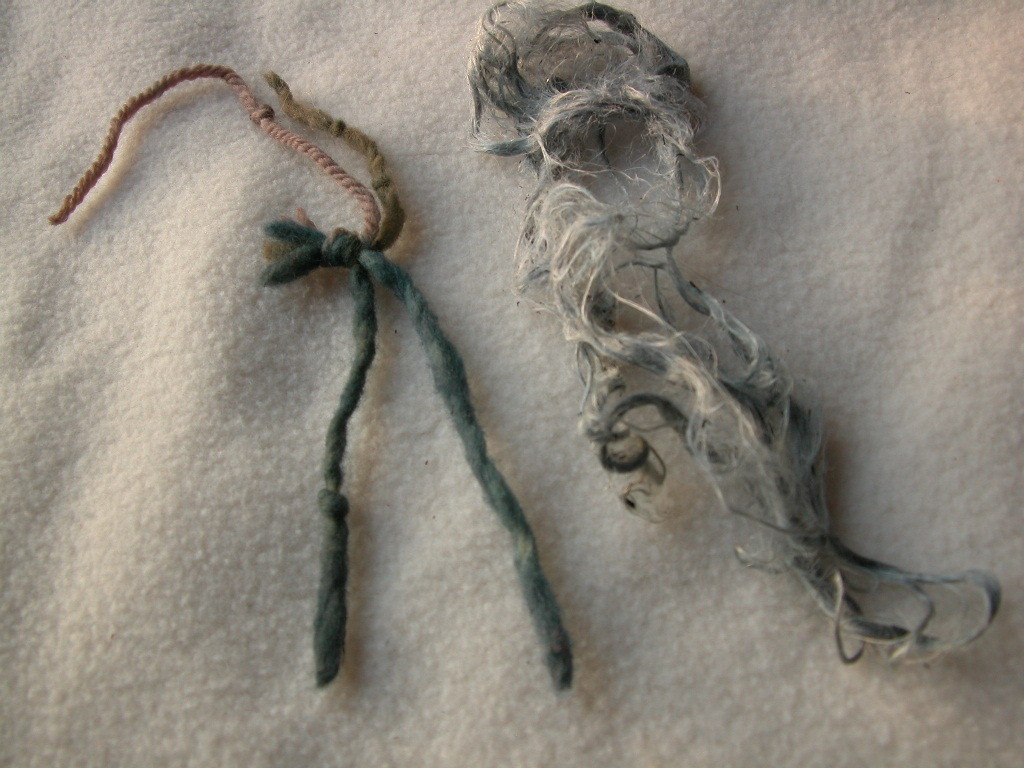
The yarn samples in this image were the first to go through the dyebath. The blue strand on the left was mordanted in alum; the one on the right had no mordant. The pinkish strand was mordanted in iron; the green one in copper. The silk on the right (mordanted in alum) went in after I took those samples out, and it didn’t pick up as much colour as I’d hoped—but it’s blue, dammit! The remaining dyebath is still a rich, deep purply brown, and a second sample of silk has been sitting in it, on medium, for most of this afternoon.
My next step is to shift the pH a bit higher with the tiniest addition of washing soda, to see if that might bring out more of the elusive blue.
And my next step after that is to put out the word to all my mushroom friends that I’ll be looking for more of these next year. Thankfully they’re not edible.
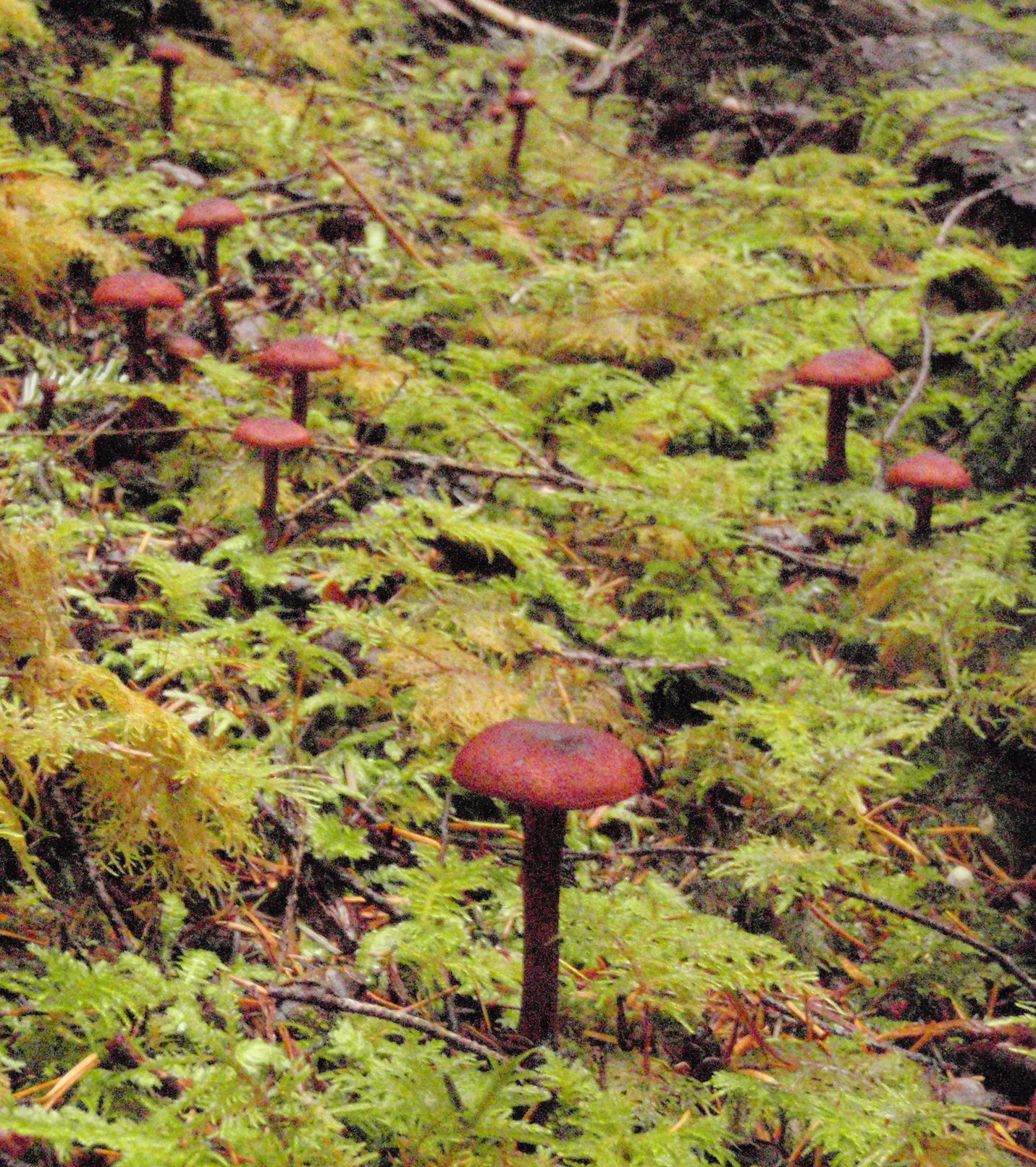
We found a spot, not that far from us but requiring a bit of effort to get to, where I found the Holy Grail—Cortinarius sanguineus—in such abundance that this year I’m going to have more than just a sample dyepot.
By the time I found this population (I don’t want to call it a cluster, because the mushrooms weren’t exactly clustered), we were running out of time and daylight, so I wasn’t able to explore further. Next year I’ll know exactly where to go, a few metres above a little stream and in fairly deep shade, and I’ll walk all along that elevation, where these little beauties obviously love their surroundings.
The dyepot will be happening soon—I think silk will be appropriate for this one!
Even though my dyepots are still going strong, it’s time to start spinning the mass of fibre accumulating around the house. The first yarn of the season, which I’m spinning now, will be a blend of these three colours.
I’m preparing the fibre on my handcarders as I go, making some rolags of one colour and some with two colours blended. This merino cards up so beautifully—it’s a dream to spin.
CELEBRATING THE BEAUTY OF SUNSHINE COAST MUSHROOMS







 SHROOMWORKS