All posts by Shroomworks

In 2003, my dearest and I decided to move to and build in an area surrounded by rainforest on BC's Sunshine Coast. So I thought it would be wise to learn about mushrooms. Little did I know that this new interest, combined with my joining the local spinners' and weavers' guild, would lead to a new passion: dyeing fibre with mushrooms. I was lucky enough to attend the 13th International Fungi & Fibre Symposium in Mendocino, California, in 2008, and from the good people there, I learned a great deal and was inspired to come home and learn even more. The story has just begun . . .

Spinning silk . . . or, What was I thinking?

Image

I saw the image on the cover of Crochet So Fine, a book of crochet patterns. I fell in love with it: a “wrap cardigan” of such exquisite lace, with a large pineapple motif centred on the back, three-quarter sleeves fashioned with intricate vertical designs, and a deep V-neck achieved by crossing one front over the other and tying wispy ties at the back.

I am not a maker of intricate crochet. I once (way, way back when) crocheted bulky toilet roll covers for everyone in the family for Christmas. I’ve crocheted mushroom tree ornaments. I tried to crochet cute little lacy strips meant to adorn the fronts of my kitchen shelves (in some sort of decorating madness) and ended up ripping everything apart and depositing the leftover crochet cotton in the thrift shop.

But when I first set eyes on that stunning crocheted wrap (“cardigan” just doesn’t do it justice), I knew I had to make it. And I had to make it with mushroom-dyed silk.

Silk comes in many forms, and I decided to dye and spin silk “hankies,” soft, fly-away bundles, each made up of eight to ten layers of gossamer. Each layer must be peeled gently from the stack, then carefully stretched, stretched, and stretched some more, until the long, weightless strand is just a few fibres thick. Then it’s time to spin.

As with most handspinning, preparing the fibre takes up the greater part of the time; once the wheel gets going, the silk fairly slides across my fingers, building up in fine layers on the bobbin. I divide each hankie into two bobbins, so that two fine strands of the same colour can be plied together into a balanced silk thread.

I then wind the silk thread into little skeins. I love to fondle these wee treasures in the sunlight, admiring the characteristic sheen imparted by true silk.

Each skein measures close to 50 yards.  I will need a little more than 2,000 yards to complete this garment. I don’t want to think of the time required to complete this garment. I am in denial that I will one day have to sit down with a crochet hook and create this garment..

Right now I’ll just enjoy spinning and fondling my silk in the sure and certain knowledge that one day, if nothing else, I’ll be laid out in a Phaeolus-dyed, handspun silk shroud.

This is why I freeze my turkeytails

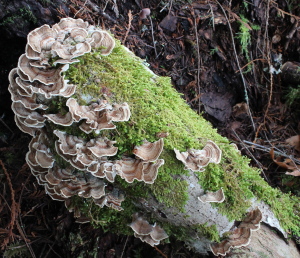
ImageIf you bring some fresh turkeytails (Trametes versicolor) home from the forest, chances are those turkeytails will be home to some tiny little mites who like to eat turkeytails. If you plan on using those turkeytails within a few weeks, it’s no problem, but if you should leave those turkeytails in a paper bag on a hidden shelf in your basement for a year or three, those little mites will have had a feast beyond their greatest expectations.

And that’s exactly what happened here. While sorting through some papermaking supplies on a basement shelf, I came upon a little bag of powdery debris topped by a few holey bits of barely recognizable turkeytails (see the two specimens on the left). The two on the right just came in from the forest and are destined for the next boil-up; the rest of my huge stash of turkeytails are sitting in the freezer until I’m ready to use them.

I freeze mushroom paper for the same reason, following which I coat it with some kind of sealer. Same goes for jewelry mushrooms, too.

Fresh turkeytails

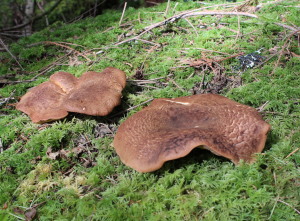
The turkeytails (Trametes versicolor) are strutting their stuff, as is their wont at this time of year. They grow in abundance on dead or dying alder and have no problem establishing a presence in our forest. (I’ve heard them referred to as the “crabgrass of the woods” for just that reason.) They thrive on a stump or log for a year and may appear in the same place the next year, but in smaller numbers. But by that time they’ll have moved on to another host.

I’m picking these now, setting aside those of jewelry quality and cooking the rest, a handful at a time, for a health-giving tea, after which they go into a holding bin until such time as I’m ready to use them for paper.

The forest is indeed generous.Image

Close-ups of the handspun

Image
Thick ‘n thin: Hydnellum
Image
Coils: Dermocybe

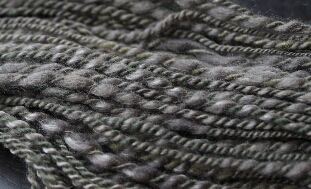
I had the good fortune to attend a spinning workshop by the amazing and inspiringJacey Boggs last summer, where she opened my eyes about the possibilities in handspun yarn. Here are some close-ups of a couple of the mushroom-dyed skeins I posted about a few days ago. The pink one, dyed with dermocybes (the darker shade was mordanted with iron), is spun with coils, while the green yarn, dyed with Hydnellum, is one thin strand plied with a thick-and-thin strand.

Now I have even more reason to fondle my handspun!

A few mushroom yarns

Image
Some of this year’s spinning

For a variety of reasons, some personal, some structural (as in setting up a studio, aka My New Happy Place), some environmental (as in this wasn’t a very good year for dye mushrooms), my dyepots have been cold for the last few months. That will soon change, however, once my new workspace is ready and functional.

My spinning wheel  hasn’t slowed down all that much, though; here are some interesting textures that resulted from some of my play sessions.

More posts to follow as soon as I can fire up the dyepots!

What a long, strange year it’s been!

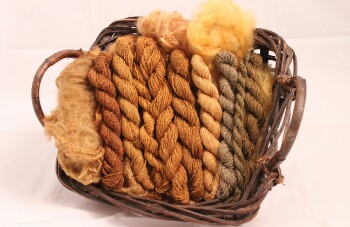
ImageAfter a very long, dry summer, we began to despair of having any sort of mushroom season at all. The Phaeolus schweinitzii (dyer’s polypore) appeared in their usual abundant numbers, so at least I’m guaranteed of having lots of gold/green/brown dyepots. Some of the other standbys turned up later than usual and in smaller numbers than usual—more about them in future posts—but for now I’m revelling in golds.

Here’s a silk scarf that’s been sitting with some chunks of Phaelous for a couple of months now—”solar” dyeing at its best, even in the midst of a foggy autumn.

Unpredictable but beautiful colours

Velvet Pax colours

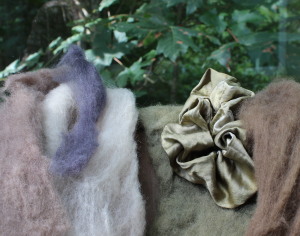
My first mushroom dyepot of the season, using Tapinella atrotomentosa (Velvet Pax) yielded the colours on the left. I’d seen some nice purple from this mushroom on unmordanted wool, and that’s what I was hoping to get on the large (unmordanted) sample at the left; it turned out to be more brown than purple. The lighter sample to its right was the exhaust bath, while the lovely purple was a small piece mordanted with alum.

(Confession: I’ve begun putting my fibre inside a very fine mesh lingerie bag so I can extract colour and dye the fibre at the same time. When this batch began to heat up, I smelled the distinct odour of washing soda, leaving me to think I hadn’t rinsed the bag completely at the end of last year’s season. My next batch with this mushroom will get a pinch of washing soda to see how that affects the colour.)

Proceeding to another batch of fresh mushrooms (and a thoroughly rinsed mesh bag), I put a large piece of alum-mordanted wool into the dyepot, and instead of purple, I got this great olive green! The alum-treated silk scrunchy also went through that dyebath, while the sample on the far right was mordanted with copper.

I wonder if the phases of the moon, or the way I crinkle my eyebrows, has anything to do with the unpredictable results from this mushroom.

Vulnerable Velvet Pax

Vulnerable velvet pax

I believe all forest creatures, including myself, must learn to live together, but dammit! I’m not prepared to let the squirrels have my dye mushrooms when they already have plenty of forest food to munch on and store away at this time of year.

These little buttons were just starting out when I found them on top of a mossy stump early in August, so I set up a twiggy-branch protection system for them (see my August 13 post) and hoped for the best.

Velvet pax untouched

Sixteen days later, here’s what I found (after removing the twigs): beautiful, untouched specimens, fresh and perfect for the dyepot. And into the pot they went, that very same day. I’ll post pictures of the results soon.

And the cycle continues . . .

Squirrels like Velvet Pax

Our latest foray into the back and beyond proved exciting—the Tapinella atrotomentosa (which I still want to call Paxillus atrotomentosus, or Velvet Pax) are beginning to appear in the usual spots, on mossy old stumps and decaying logs. I even found a few in the roots of an old cedar—I usually see them on Douglas fir. I’m not the only one attracted to these beauties, however. These little gnaw marks are clear evidence that I’m in competition with squirrels.

Protecting the button mushroom

Because I’m selfish with my dye mushrooms, I decided to try a trick I’ve employed in my vegetable garden, to keep cats out of my freshly dug garden beds: I gathered up a bunch of twiggy branches and made a protective little cage over this button in the hope it can grow intact to a usable size.

In the meantime, my first dyepot of the season, using the bits of Velvet Pax the squirrels decided to leave for me, is now under way, along with marathon mordanting sessions. Bring on the dye mushrooms!

The one-dyepot scarf

From Cortinarius sanguineus

This is made with the wool that went through my Cortinarius sanguineus dyepot—the small wine-coloured mushrooms that pack such powerful colour (see my post of February 9). Any dyed wool, once it’s spun, will lose some of its colour intensity, so I didn’t expect this to work up in the bright red I started with. Nevertheless, I’m pleased with the results.

I spun this Merino more tightly than I’d planned to, so after it was chain-plied, the three-ply yarn felt more like a soft cord. I decided to do some improv crocheting and ended up with this very long scarf-like garment that wraps around my neck three times, with lots left over to play with.