
Just recently I’ve noticed a lot of interest in mushroom dyeing in my community, so I’m excited about getting other people excited!
An art class of eight- and nine-year-old girls invited me to show them what it involves. Most of them had been told by their parents (as was I, many years ago) that you should never, ever touch a mushroom because it could kill you. I understand the fear behind that admonition, but we don’t tell our children to never, ever touch any leaves or wild berries, even though some of those can be pretty dangerous, too. We teach them not to eat anything in the wild without first knowing what it is, and that’s how it should be with mushrooms, as well.

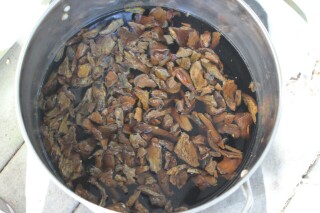
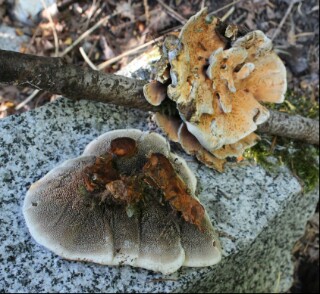
So I put the class to work breaking up a good selection of dried Phaeolus schweinitzii and putting the pieces into fine lingerie bags—this polypore had acquired a bit of fuzzy fungus of its own, but that didn’t seem to affect the end colour.
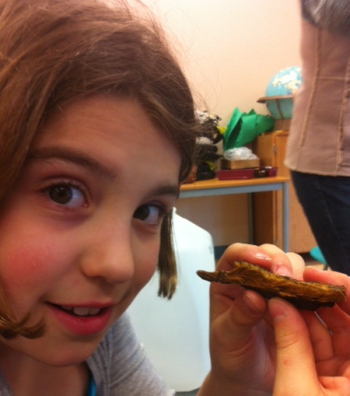
And it wasn’t long before everyone was right into it.

We talked about mordants and how they work, and everyone prepared samples. I follow the practice of giving each sample a different number of knots, depending on its mordant. Traditionally, this was:
No mordant: no knot; Alum: 1 knot; Chrome: 2 knots ; Tin: 3 knots ; Copper: 4 knots; Iron: 5 knots.
Although some dyers use chrome and tin, I prefer not to, so I couldn’t see myself tying four and five knots in my copper and iron samples when I didn’t have to. So I’ve devised my own easier system: No mordant: no knot; Alum: 1 knot; Iron: 2 knots; Copper: 3 knots. (The word iron has fewer letters than the word copper, my way of remembering the knots.)

The dyepots had been simmering while we got the samples ready, then everyone watched with interest as the samples went into the hot liquid, along with some pieces of wool batt. The anticipation built as the pots simmered and the classroom filled with the unmistakable odour of cooking mushrooms.

At last, the wool was ready! I understand everyone went home with some good dinner-table stories, and in a few weeks we’ll get together again and use this wool to make little felted bowls.
Then the following week, a few members of the Sunshine Coast Spinners & Weavers Guild got together for the first of three mushroom workshops. We’re focusing on one mushroom per session, which gives everyone a chance to learn what to look for and where to find it, and we also have more opportunity to experiment with that mushroom. In this case, I wanted to see if we’d get much difference between well water and chlorinated water, so one of the members who’s on a city system brought a couple of containers of her water.

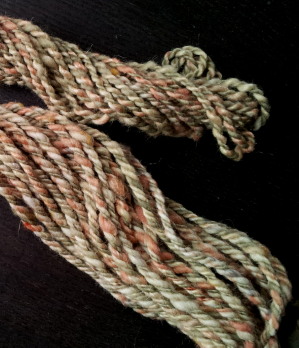
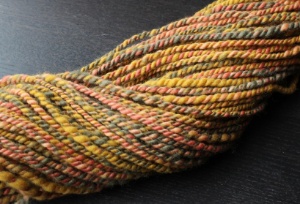
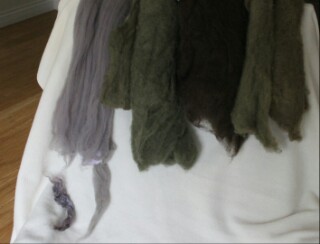
Our samples were premordanted with alum, iron, and copper, and we also put some alum-mordanted samples in iron and copper afterbaths. Unfortunately, we didn’t get the bright gold of the children’s dyepot, but we did find that using chlorinated water made only a marginal difference in the colours. More images of that day can be found at the blog of the Sunshine Coast Fibreshed, a new affiliate of the larger Fibreshed movement promoting local fibres, local dyes, and local artisans. We’re excited to see how this is taking shape, and mushroom dyeing certainly fits within this idea.








 SHROOMWORKS